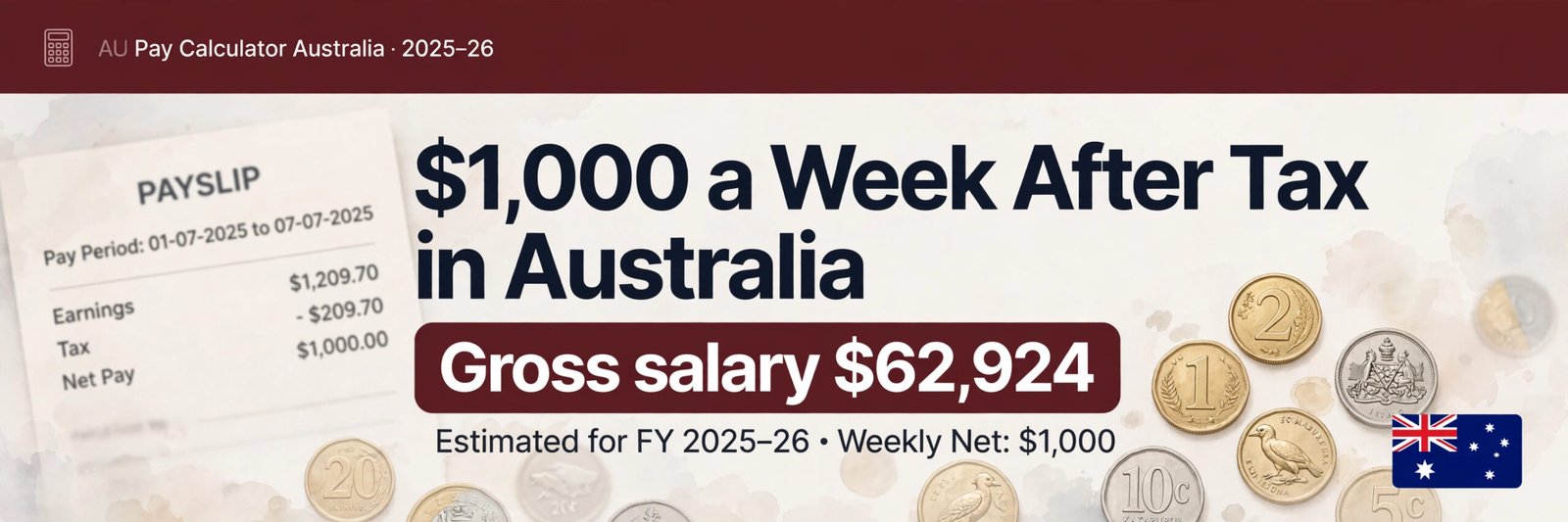
When Australians talk about pay, the number that really matters is the one that lands in the bank account. A job advertised at $60,000 a year sounds straightforward — until tax and the Medicare levy take their cut and the weekly figure comes out lower than expected. So if your goal is a clean $1,000 a week after tax, the question is: what gross salary do you actually need to earn to get there?
The short answer, using the official 2025–26 Australian resident tax rates, is a gross salary of about $62,924 a year, or roughly $1,210 a week before tax. After income tax of $9,665 and the 2% Medicare levy of $1,258, you keep exactly $52,000 a year — $1,000 a week. This guide shows the full calculation, how the figure changes at different pay levels, and the factors that can push your take-home pay up or down. You can check your own numbers with our free net to gross calculator.
$1,000 a week after tax: the quick answer
For an Australian resident for tax purposes in 2025–26, with no HECS-HELP debt, no salary packaging and no tax deductions, the numbers look like this:
| Pay period | Gross pay | Income tax | Medicare levy | Take-home pay |
|---|---|---|---|---|
| Annual | $62,924 | $9,665 | $1,258 | $52,000 |
| Monthly | $5,244 | $805 | $105 | $4,333 |
| Fortnightly | $2,420 | $372 | $48 | $2,000 |
| Weekly | $1,210 | $186 | $24 | $1,000 |
In other words, you need to earn about $210 a week more than your target before tax. Your overall effective tax rate — income tax plus Medicare — is roughly 17.3%, well below the 32% marginal rate that applies to your last dollars of income. That gap between marginal and effective rates is the key to understanding Australian tax, and it is why a simple “take 30% off” rule of thumb overstates what most middle-income earners actually pay.
How the $62,924 figure is calculated
Australia uses a progressive (marginal) tax system. Each slice of your income is taxed at a different rate — only the portion inside each bracket attracts that bracket’s rate, never your whole income. The 2025–26 resident rates are:
| Taxable income | Tax on this income |
|---|---|
| $0 – $18,200 | Nil (tax-free threshold) |
| $18,201 – $45,000 | 16c for each $1 over $18,200 |
| $45,001 – $135,000 | $4,288 plus 30c for each $1 over $45,000 |
| $135,001 – $190,000 | $31,288 plus 37c for each $1 over $135,000 |
| $190,001 and over | $51,638 plus 45c for each $1 over $190,000 |
Applying those rates to $62,924: the first $18,200 is tax-free, the next $26,800 is taxed at 16% ($4,288), and the remaining $17,924 is taxed at 30% ($5,377) — a total income tax bill of $9,665. Add the 2% Medicare levy ($1,258) and total deductions come to $10,923, leaving $52,000 in your pocket. Note that these figures exclude the Low Income Tax Offset (LITO), which can reduce tax by up to $700 for lower incomes, and any work-related deductions you claim at tax time — both would increase your take-home pay slightly.
What gross salary gives you other weekly take-home amounts?
If $1,000 a week is not quite your target, this table reverses the calculation for other common goals. It shows the gross salary you need to clear each weekly amount after tax and Medicare in 2025–26:
| Target take-home pay | Gross salary needed | Gross weekly pay | Income tax | Medicare levy |
|---|---|---|---|---|
| $800/week | $47,629 | $916 | $5,077 | $953 |
| $900/week | $55,276 | $1,063 | $7,371 | $1,106 |
| $1,000/week | $62,924 | $1,210 | $9,665 | $1,258 |
| $1,100/week | $70,571 | $1,357 | $11,959 | $1,411 |
| $1,200/week | $78,218 | $1,504 | $14,253 | $1,564 |
| $1,500/week | $101,159 | $1,945 | $21,136 | $2,023 |
Notice how the gap between gross and net widens as income rises. At $800 a week take-home, you only need $116 a week extra before tax; at $1,500 a week, the gap is $445 a week. That is the progressive system at work — higher slices of income are taxed at higher rates, so each extra dollar of take-home pay costs more gross income to produce.
What $1,000 a week after tax means as an hourly rate
If you work the standard full-time week of 38 hours, a $62,924 salary works out to about $31.84 an hour before tax. On a casual basis, the same take-home target is easier to reach on paper — casual loading of 25% means a casual rate of around $31.84 would already include the loading — but casual work comes without paid leave, so the comparison is not like-for-like. If you are comparing offers, our hourly to salary calculator converts any hourly rate into annual take-home pay, and our salary calculator does the reverse.
It is also worth remembering what sits on top of your salary: your employer must pay superannuation guarantee contributions of 12% on top of your ordinary time earnings. On $62,924, that is about $7,551 a year into your super fund — money you do not see in your weekly pay but which is very much part of your total remuneration.
What can change your take-home pay?
The $62,924 figure assumes a straightforward situation. Several common factors move it:
- HECS-HELP debt: If you have a study loan, compulsory repayments are withheld from your pay on top of tax. From 2025–26, repayments use a marginal system, and at an income of around $63,000 the repayment rate starts at 15c on income above $67,000 under the reformed thresholds — so at $62,924 you may owe little or nothing, but as your income rises past $67,000, repayments begin and your take-home pay falls.
- Salary packaging: Salary sacrificing part of your pay into super or fringe benefits reduces your taxable income, which can increase your after-tax position — though money sacrificed into super is locked away until retirement.
- Tax deductions: Work-related expenses, donations and other deductions reduce your taxable income at tax-return time, which can mean a refund that effectively boosts your annual take-home pay above the weekly figure.
- Medicare levy surcharge: This does not apply at this income level for most people, but high earners without private hospital cover pay an extra 1–1.5%.
- Second jobs and side income: Extra income is taxed at your marginal rate (30% plus Medicare at this level), so a side hustle adds less to your pocket than its headline amount suggests.
Is $1,000 a week after tax a good salary?
A take-home pay of $1,000 a week — $52,000 a year in your pocket — sits close to the middle of the Australian income distribution for full-time workers, and well above the national minimum wage. For a full-time worker on the minimum wage of $26.44 an hour from 1 July 2026, gross annual pay is about $52,200 and take-home pay is roughly $44,700 a year, or about $860 a week. So $1,000 a week after tax represents a meaningful step above the minimum-wage baseline.
Whether it feels comfortable depends heavily on where you live. In Sydney or Melbourne, $1,000 a week after tax covers the basics for a single person but leaves limited room for saving after rent. In regional areas or smaller cities, the same amount stretches considerably further. Housing is the single biggest variable: the difference between a $400-a-week and a $650-a-week rent dwarfs most tax-planning gains.
How to reach $1,000 a week after tax
If your current take-home pay is below $1,000 a week, the levers are straightforward. First, check whether your gross salary is actually close to $62,924 — many people underestimate the gross figure they need because they apply a flat percentage to their target. Second, consider whether overtime, penalty rates or a higher casual loading could close the gap without a job change. Third, when negotiating, negotiate on the gross figure: asking for “$1,000 a week after tax” is ambiguous, but asking for a $63,000 salary is precise and lets your employer cost it properly. Finally, review your tax position at return time — claiming every legitimate deduction is the simplest way to lift your effective take-home pay.
Frequently asked questions
What salary do I need to take home $1,000 a week in Australia?
About $62,924 a year gross in 2025–26, assuming you are an Australian resident for tax purposes with no HECS-HELP debt or salary packaging. That is roughly $1,210 a week before tax.
How much tax do you pay on $62,924 in Australia?
Income tax of $9,665 plus the 2% Medicare levy of $1,258, for total deductions of $10,923. Your effective tax rate is about 17.3%.
Is $1,000 a week after tax the same as $52,000 a year?
Yes — $1,000 multiplied by 52 weeks equals $52,000 a year of take-home pay. Note that monthly take-home pay is $4,333, not $4,000, because a month is longer than four weeks.
Does the $62,924 figure include superannuation?
No. Superannuation guarantee contributions of 12% are paid by your employer on top of your salary — about $7,551 a year on $62,924 — and do not reduce your take-home pay.
What if I have a HECS-HELP debt?
At around $63,000 of income you are below the 2025–26 repayment threshold of $67,000, so compulsory HECS repayments may not apply yet. Once your income passes $67,000, repayments begin at marginal rates and your take-home pay will be lower than the figures in this guide.
How can I calculate my own take-home pay?
Use our free net to gross calculator to work backwards from any target weekly amount, or the salary calculator to work forwards from a gross salary.
The bottom line
To take home $1,000 a week in Australia in 2025–26, you need a gross salary of about $62,924 a year. Tax takes $9,665 and Medicare takes $1,258, leaving $52,000 in your pocket. The figure is a useful anchor for salary negotiations, job comparisons and budgeting — but remember it is a baseline, not a promise: HECS repayments, deductions, offsets and salary packaging can all shift your personal number. Run your own figures through the net to gross calculator before making a decision based on a single headline salary.