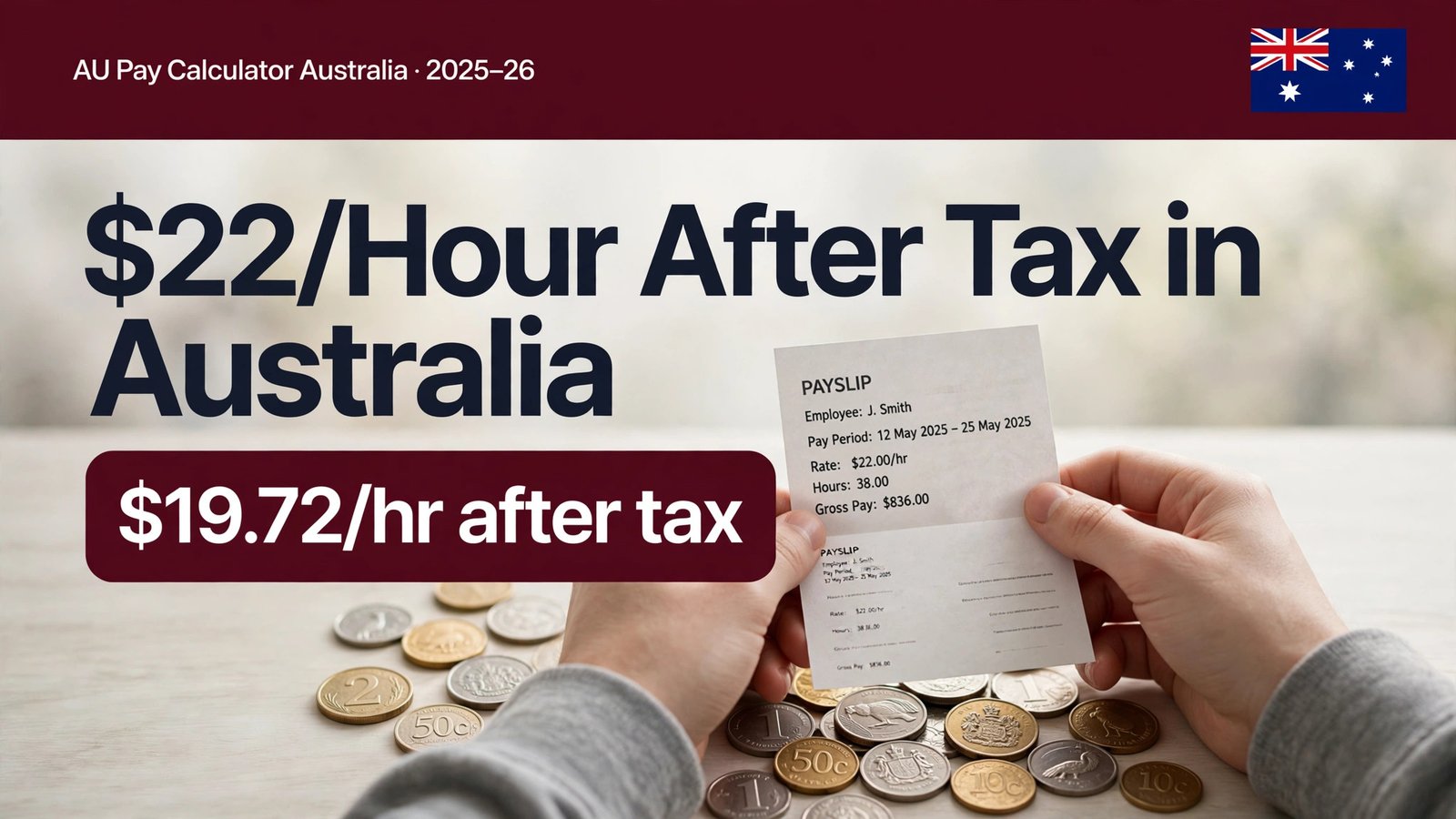
$22 an hour after tax in Australia works out to approximately $19.72 per hour for a full-time adult employee in the 2025-26 financial year. On a standard 38-hour week worked across all 52 weeks of the year, that hourly rate produces a gross annual salary of $43,472 — and after income tax, the Medicare levy and the low income tax offset are applied, you keep $38,960.44 of it. That is an effective tax rate of just 10.4%, because most of your income sits in the lowest taxed bracket and the low income tax offset takes a further bite out of the bill.
Before we get into the numbers, there is something you need to know: $22 an hour is below Australia’s national minimum wage for a full-time adult employee. From 1 July 2026 the national minimum is $26.44 an hour, so an adult working full-time hours on $22 an hour would be underpaid. The rate does still appear in legitimate contexts — junior wages and casual arrangements, covered in detail below — but if you are an adult permanent employee, this guide doubles as a warning sign. Check your own numbers with our hourly to salary calculator.
$22 an Hour After Tax: The Short Answer
Here is the quick version. A full-time employee working 38 hours a week, 52 weeks a year (1,976 hours in total) at $22 an hour earns $43,472 before tax. After the 2025-26 income tax rates, the 2% Medicare levy and the low income tax offset are applied, take-home pay lands at $38,960.44 a year. That works out to $749.24 a week in your pocket — or $19.72 for every hour worked.
| Measure | Gross | After tax |
|---|---|---|
| Hourly | $22.00 | $19.72 |
| Weekly (38 hrs) | $836.00 | $749.24 |
| Annual | $43,472.00 | $38,960.44 |
These figures assume you are an Australian resident for tax purposes, have no other income, claim the tax-free threshold, and have no salary-sacrifice arrangements. If your situation is more complex, the hourly to salary calculator can model it — the ATO publishes the full rate tables at ato.gov.au.
Annual Salary Breakdown: From $43,472 Gross to $38,960.44 Take-Home
With $43,472 of taxable income you sit entirely inside the second income tax bracket for 2025-26: $18,201 to $45,000, taxed at 16 cents in the dollar. The first $18,200 of your income is tax-free. The remaining $25,272 ($43,472 minus $18,200) is taxed at 16%, which gives $4,043.52 of income tax. Because you are well short of the $45,000 threshold, none of your income reaches the 30-cent bracket. These are the resident individual income tax rates published by the ATO for 2025-26 (ato.gov.au).
| Component | Amount |
|---|---|
| Gross annual income ($22 × 38 hrs × 52 wks) | $43,472.00 |
| Income tax (16c on $25,272 above $18,200) | $4,043.52 |
| Less: Low income tax offset (LITO) | −$401.40 |
| Plus: Medicare levy (2% of $43,472) | +$869.44 |
| Total tax and levies | $4,511.56 |
| Take-home pay | $38,960.44 |
| Effective tax rate ($4,511.56 ÷ $43,472) | 10.4% |
The low income tax offset does a lot of quiet work here. The maximum LITO is $700, and it reduces by 5 cents for every dollar of taxable income above $37,500. On $43,472 that reduction is 5 cents × $5,972 = $298.60, leaving an offset of $700 − $298.60 = $401.40 (ato.gov.au). Without the offset you would owe $4,043.52 + $869.44 = $4,912.96 — an effective rate of 11.3%. The LITO wipes $401.40 off that bill and drags your effective rate down to 10.4%. This is why take-home pay at this income level is noticeably kinder than the headline 16-cent bracket suggests.
The Medicare levy is simpler: it is a flat 2% of taxable income for full-time adult residents, which comes to $869.44 on $43,472. The full 2% rate applies because $43,472 is above the $35,013 upper threshold where the levy shades in from nil (the levy is nil below $28,011 for singles in 2025-26, per ato.gov.au). Add it all together — $4,043.52 + $869.44 − $401.40 — and your total tax and levies are $4,511.56, leaving $38,960.44 in your pocket.
$22 an Hour Across Every Pay Period
Most people do not think in annual figures — they think in weekly or fortnightly pay. Here is what $22 an hour looks like gross and after tax across every common pay period, based on a 38-hour week and the same 2025-26 tax calculation. The after-tax figures are simply your $38,960.44 annual take-home divided by the number of pay periods in the year.
| Pay period | Gross | After tax |
|---|---|---|
| Hourly | $22.00 | $19.72 |
| Weekly | $836.00 | $749.24 |
| Fortnightly | $1,672.00 | $1,498.48 |
| Monthly (averaged) | $3,622.67 | $3,246.70 |
| Yearly | $43,472.00 | $38,960.44 |
A couple of practical notes. The monthly figure is an average (annual divided by 12), because calendar months contain different numbers of working days — useful for budgeting, but your actual payslip will vary. The fortnightly figure is the one most casual and part-time workers will recognise. If your hours vary week to week, run your actual hours through the hourly to salary calculator rather than relying on the full-time averages above.
Is $22 an Hour Legal in Australia?
This is the most important section of this guide, so let us be blunt. From 1 July 2026, Australia’s national minimum wage is $26.44 per hour — or $1,004.90 per week for a full-time 38-hour week. That figure comes from the Fair Work Commission’s Annual Wage Review 2026-27 decision (fairwork.gov.au). At $22 an hour, a full-time adult employee is being paid $4.44 an hour below the legal minimum. Over a 38-hour week that is a shortfall of $168.72; over a full year it is $8,774.40 in wages you are legally owed.
Two further points matter. First, the national minimum wage is a floor, not a ceiling: most employees are covered by an award or enterprise agreement that sets a minimum above $26.44 an hour. Your actual legal minimum may be higher than the national figure, never lower. Second, if your payslip shows an adult full-time rate below your entitlement, that is underpayment — and the Fair Work Ombudsman can help you recover it. Check your rate against your award at fairwork.gov.au.
When $22 an Hour Can Be Legal
There are genuine contexts in which an hourly figure around $22 appears lawfully. The two main ones:
- Junior rates. Employees under 21 are commonly paid a percentage of the adult rate under their award — for example, a percentage-based junior rate for a 17- or 18-year-old can land at or near $22 an hour while remaining entirely lawful. Junior percentages vary by award and age, so the exact figure depends on your classification.
- Casual employment. Casuals receive a 25% casual loading on top of the base hourly rate to compensate for not receiving paid annual leave, paid sick leave and other permanent entitlements. A $22 base rate plus 25% loading equals $27.50 an hour ($22 × 1.25) — which is above the $26.44 minimum wage. So while a $22 base rate for a casual is lawful, the casual must actually receive the loaded $27.50 rate, not $22 flat.
The pattern to watch for is an employer paying a flat $22 an hour to an adult while calling the role “casual” without applying the loading, or paying junior rates to someone who has turned 21. Both are underpayment. If either sounds familiar, compare your age, employment type and award at fairwork.gov.au — and keep your payslips.
Casual vs Permanent: Take-Home Compared
Because $22 an hour sits below the adult permanent minimum but works lawfully as a casual base rate, it is worth comparing the two side by side. The permanent column uses the national minimum wage of $26.44 an hour (the legal floor for an adult full-time employee); the casual column uses the $22 base plus 25% loading. Both assume 38-hour weeks for comparison — many casuals work fewer or irregular hours, which would scale these figures down.
| Scenario | Effective hourly rate | Weekly gross | Annual gross |
|---|---|---|---|
| Permanent adult at national minimum wage | $26.44 | $1,004.90 | $52,254.80 |
| Casual on $22 base + 25% loading | $27.50 | $1,045.00 | $54,340.00 |
On paper the casual comes out ahead: $27.50 an hour versus $26.44, or about $40.10 more per week in gross pay. That gap is the whole point of casual loading — it is not a bonus, it is compensation for going without paid annual leave, paid sick leave, and permanent job security. Whether the trade-off favours you depends on your circumstances: the loading rewards flexibility and higher immediate cash flow, while permanent entitlements reward paid time off and stability.
One more useful number at this income level: your marginal tax rate is 18 cents in the dollar — 16 cents of income tax plus 2 cents of Medicare levy. Every extra dollar you earn above $43,472 (up to $45,000) costs 18 cents in tax and leaves 82 cents in your pocket. Above $45,000 the income tax component steps up to 30 cents, so overtime gets taxed noticeably harder past that line. You can model extra hours with the $22-an-hour pay breakdown.
Frequently Asked Questions
How much is $22 an hour per year after tax in Australia?
For a full-time employee (38 hours a week, 52 weeks a year) in 2025-26, $22 an hour produces a gross annual salary of $43,472 and take-home pay of $38,960.44 after income tax, the Medicare levy and the low income tax offset — $749.24 a week, or about $19.72 an hour in your pocket.
Is $22 an hour a legal wage in Australia?
Not for a full-time adult permanent employee — it is $4.44 an hour below the national minimum wage of $26.44 an hour that applies from 1 July 2026. It can be legal as a junior rate (under-21s paid a percentage of the adult rate under their award) or as a casual base rate, where the 25% casual loading brings the actual paid rate to $27.50 an hour.
What is $22 an hour as a casual rate after the loading?
A $22 base rate plus 25% casual loading equals $27.50 an hour. On a full-time-equivalent 38-hour week that is $1,045.00 a week gross, or $54,340.00 a year gross — above the $26.44 national minimum wage. Remember the loading compensates for having no paid annual or sick leave.
How much tax do I pay on $43,472 a year?
In 2025-26 you pay $4,043.52 in income tax (16 cents on every dollar above the $18,200 tax-free threshold), plus $869.44 in Medicare levy, minus a $401.40 low income tax offset — a total of $4,511.56. That is an effective tax rate of 10.4%, well below the 16-cent marginal rate, thanks to the tax-free threshold and the offset (ato.gov.au).
Does $22 an hour include superannuation?
No — superannuation is paid on top of your wages, not deducted from your take-home pay. Under the Super Guarantee, your employer must contribute 12% of your ordinary earnings to your super fund. On a $43,472 salary that is an extra $5,216.64 a year going into your retirement savings, separate from the $38,960.44 you take home.
How does $22 an hour compare to the minimum wage?
It falls short. The national minimum wage from 1 July 2026 is $26.44 an hour ($1,004.90 a week full-time), so $22 an hour is $4.44 an hour — $168.72 a week — below the legal minimum for an adult employee (Fair Work Commission Annual Wage Review 2026-27, via fairwork.gov.au). See the full $22 hourly pay breakdown for the detailed numbers.
The Bottom Line
$22 an hour after tax in Australia is $19.72 an hour, or $38,960.44 a year take-home on a $43,472 full-time salary in 2025-26 — taxed at an effective rate of just 10.4% once the tax-free threshold, the $401.40 low income tax offset and the 2% Medicare levy are all accounted for. But the number that matters most in this guide is not the tax figure: it is the $26.44 national minimum wage. If you are an adult employee being paid a flat $22 an hour, check your award and your payslip — you may be owed more. Want to run your own hours, or compare rates? Try the hourly to salary calculator and see exactly what lands in your pocket.