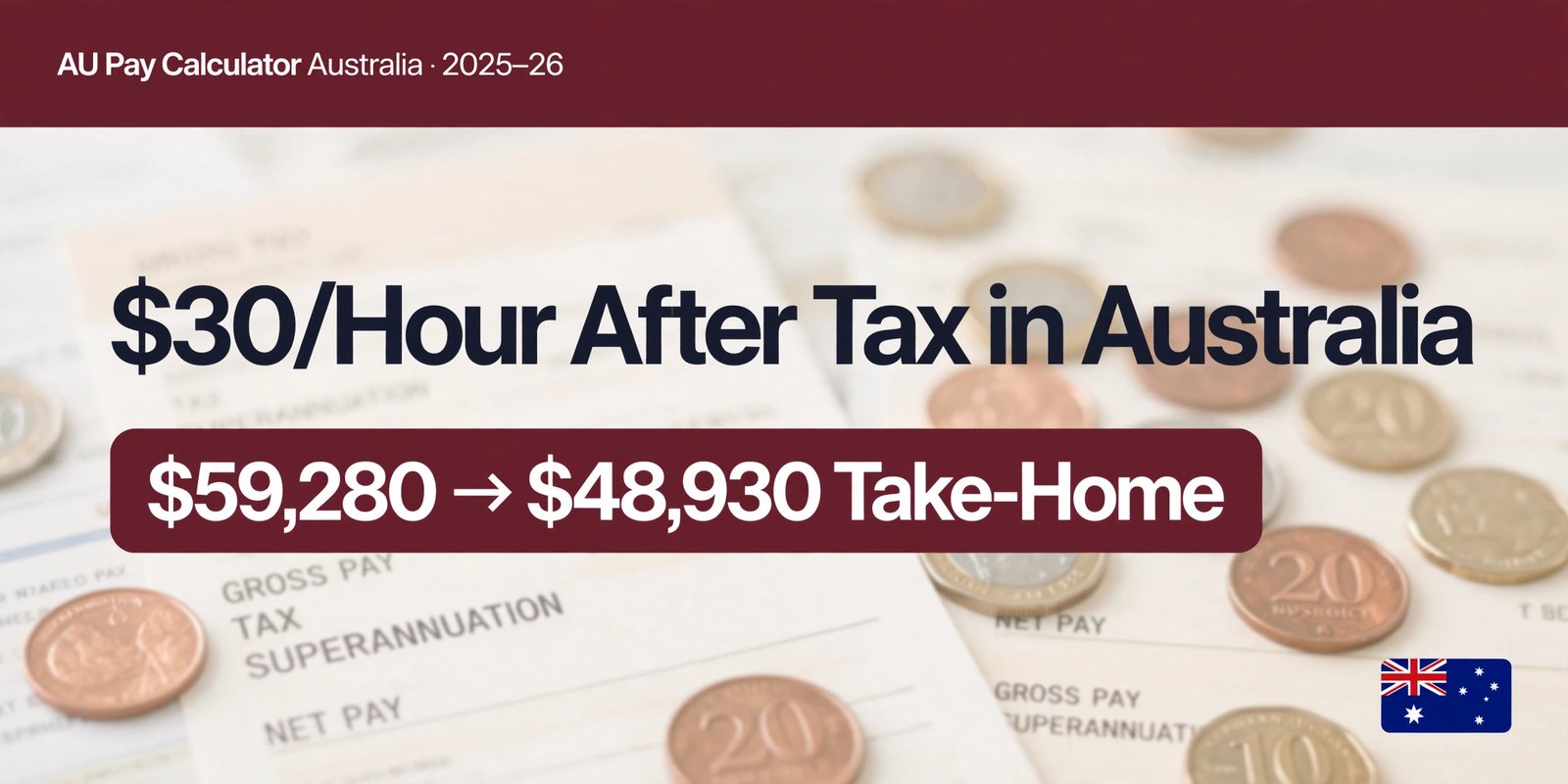
Earning $30 an hour in Australia sounds like solid pay — and it is, for many roles in retail, hospitality supervision, trades assistance, warehousing and entry-level office work. But your gross hourly rate and what actually lands in your bank account are two different things. On a full-time 38-hour week, $30 an hour equals $59,280 a year before tax. After income tax, the Medicare levy and other deductions, your real take-home is closer to $24.76 an hour, or $48,929.60 a year.
In this guide we break down exactly where every dollar goes: the 2025–26 tax brackets that apply at this income, why the Low Income Tax Offset doesn’t help you here, how casual loading changes the picture, and what you’d earn working part-time. All figures follow the $30/hr after-tax calculator so you can check the numbers yourself.
$30/Hour: Your Gross Pay by Pay Period
Before we touch tax, let’s look at what $30 an hour means across every pay cycle on a standard 38-hour full-time week. This is the starting figure your employer uses before PAYG withholding is applied.
| Period | Gross Pay | Take-Home (After Tax) |
|---|---|---|
| Hourly | $30.00 | $24.76 |
| Weekly (38 hrs) | $1,140.00 | $940.95 |
| Fortnightly | $2,280.00 | $1,881.91 |
| Monthly | $4,940.00 | $4,077.47 |
| Annual (52 weeks) | $59,280.00 | $48,929.60 |
So the headline number is $59,280 gross versus $48,929.60 take-home — a gap of $10,350.40 across the year. That gap isn’t a single deduction. It’s a stack of three different obligations, and understanding each one helps you see where you could legally pay less (for example, through deductions at tax time).
How Your $10,350.40 Annual Tax Bill Is Calculated
Australia uses a progressive tax system, which means you don’t pay one flat rate on your whole income. Each slice of your income is taxed at its own rate. Here’s how the 2025–26 resident tax brackets (the modified Stage 3 rates, in place since 1 July 2024) apply to $59,280.
| Tax Component | How It’s Calculated | Annual Amount |
|---|---|---|
| Income tax — $0 to $18,200 | Tax-free threshold (0%) | $0.00 |
| Income tax — $18,201 to $45,000 | $26,800 × 16% | $4,288.00 |
| Income tax — $45,001 to $59,280 | $14,280 × 30% | $4,284.00 |
| Subtotal: income tax | $8,572.00 | |
| Medicare levy | $59,280 × 2% | $1,185.60 |
| HELP/HECS repayment | $59,280 × 1% (compulsory repayment rate at this income) | $592.80 |
| Total annual tax | $10,350.40 |
Two things to note about this breakdown. First, the effective tax rate is about 17.5% — much lower than the 30% marginal rate, because your marginal rate only applies to the slice of income above $45,000. Second, the HELP/HECS line only applies if you have a study or training loan. If you don’t, that $592.80 stays in your pocket and your take-home rises to roughly $49,522 a year (about $25.07 an hour). The figures in the table above follow the site’s standard assumption, which includes the repayment.
Want to play with the numbers yourself? The income tax calculator lets you plug in any annual income and see the full breakdown instantly.
Why the Low Income Tax Offset Doesn’t Save You Here
You may have heard about the Low Income Tax Offset (LITO), worth up to $700 a year. Here’s why it barely helps on $30 an hour. LITO is paid in full only on incomes of $37,500 or less. It then tapers: between $37,501 and $45,000 it shrinks by 5 cents per dollar, and between $45,001 and $66,667 it shrinks by 1.5 cents per dollar until it disappears entirely.
At $59,280, you’re deep in the taper zone. The offset left for you is $325 minus 1.5 cents on every dollar over $45,000 — that works out to roughly $111. That’s not nothing, but it’s a small footnote compared with your $8,572 income tax bill, and standard pay calculators don’t factor it into the take-home estimate. If you’re on a lower hourly rate, though, LITO matters a lot more: on $50,000 it’d be worth about $250, and on $40,000 about $575.
Casual Workers: $30/Hour Plus 25% Loading
Casual employees in Australia receive a 25% casual loading on top of the base hourly rate to compensate for not getting paid leave. On a $30 base rate, that means:
- Casual hourly rate: $30 × 1.25 = $37.50 per hour
- Casual annual gross (38 hrs/week): $37.50 × 38 × 52 = $74,100
- Income tax: $4,288 + ($74,100 − $45,000) × 30% = $13,018
- Medicare levy: $74,100 × 2% = $1,482
- HELP repayment: $74,100 × 3% (the higher repayment rate at this income) = $2,223
- Casual annual take-home: roughly $57,377, or about $29.05 an hour
The loading makes a real difference — nearly $8,500 extra in your pocket each year on full-time hours. The trade-off is no annual leave, no sick leave and no guaranteed hours. Whether the loading is worth it depends on how much you value job security versus the pay bump.
Part-Time Example: $30/Hour, 3 Days a Week
Not everyone works the full 38-hour week. If you work three standard 7.6-hour days — 22.8 hours a week — at $30 an hour, the numbers look like this:
- Annual gross: $30 × 22.8 × 52 = $35,568
- Income tax: ($35,568 − $18,200) × 16% = $2,778.88
- Medicare levy: $35,568 × 2% = $711.36
- Annual take-home: roughly $32,077.76, or about $616.88 a week
Notice there’s no HELP repayment at this income — you’re below the compulsory repayment threshold — and your marginal rate drops to just 16%. The effective tax rate on part-time hours is only about 9.8%. This is why the jump from part-time to full-time hours feels smaller in your bank account than on paper: every extra hour above $45,000 a year is taxed at 30% plus Medicare.
Don’t Forget Super: Your Employer’s 12% Contribution
Your $30 hourly rate doesn’t include superannuation. Since 1 July 2025, employers must pay the Superannuation Guarantee at 12% of your ordinary time earnings on top of your wage. On full-time hours that’s:
- Extra per hour: $30 × 12% = $3.60
- Extra per year: $59,280 × 12% = $7,113.60 paid into your super fund
That $7,113.60 is part of your total compensation even though it never appears in your take-home pay. It also means the true cost of employing you is closer to $66,394 a year — a useful figure to know if you’re ever negotiating a salary package instead of an hourly rate.
Is $30 an Hour a Good Wage in Australia?
Context matters. At $59,280 a year full-time, you’re earning roughly in line with the lower-middle of Australia’s full-time wage distribution — comfortably above the national minimum wage ($24.95 an hour) but below the median full-time salary. For a single person renting outside the most expensive inner-city areas, it’s a workable wage, especially with no HELP debt. In Sydney or Melbourne’s inner suburbs, it can feel tight once rent and transport are accounted for.
What $30 an hour buys you depends heavily on your situation: a couple with two incomes can live comfortably; a single income supporting a family will feel the pressure. The good news is that at 30%, your marginal tax rate is still moderate — overtime and pay rises keep most of their value. A $2-an-hour raise to $32, for instance, is worth about $1.36 an hour after tax, not the full $2, but still a meaningful lift.
If you’re comparing offers, use the hourly to salary calculator to convert any hourly rate to its annual equivalent and see the after-tax figure before you sign.
FAQ: $30 an Hour After Tax in Australia
How much is $30 an hour per year in Australia?
On a standard 38-hour full-time week, $30 an hour equals $59,280 a year gross ($30 × 38 × 52). After tax, Medicare and HELP repayment, take-home pay is about $48,929.60 a year — or around $49,522 if you have no HELP debt.
What is $30 an hour after tax per week?
Gross weekly pay is $1,140. After-tax weekly take-home is about $940.95, following the standard estimate (income tax + Medicare levy + HELP repayment).
Do I pay tax on $30 an hour if I work part-time?
Yes, but less. Australia’s tax-free threshold is $18,200, so you pay no income tax on the first $18,200 you earn each year. On part-time hours earning $35,568 a year, you’d pay about $2,779 in income tax plus $711 in Medicare levy — an effective rate under 10%.
Why is my payslip different from the calculator’s figure?
Your employer’s PAYG withholding is an estimate that assumes you’ll earn the same amount all year. Differences can come from overtime, bonuses, unpaid leave, salary-sacrificed amounts, private health insurance, or adjustments at tax time. Your tax return evens everything out — withholding is never the final word.
Does $30 an hour include superannuation?
No. Your employer’s 12% Superannuation Guarantee is paid on top of your $30 hourly rate. That’s an extra $3.60 an hour, or $7,113.60 a year on full-time hours, going into your super fund.
How much tax do I pay on overtime at $30 an hour?
Overtime hours that push your annual income above $45,000 are taxed at your 30% marginal rate plus the 2% Medicare levy (and your HELP rate if applicable). So an extra hour at $30 keeps roughly $20.40 after tax — still well worth working if the hours are available.
The Bottom Line
$30 an hour in Australia means $59,280 a year before tax and roughly $48,929.60 in your pocket — about $24.76 an hour after tax, or $940.95 a week. Your $10,350.40 annual tax bill breaks down into $8,572 of income tax, $1,185.60 of Medicare levy, and a $592.80 HELP repayment (if you have a study loan). Add the 12% super guarantee on top, and your total package is worth over $66,000 a year.
These are estimates based on 2025–26 tax rates and a 38-hour week — your exact take-home depends on your hours, deductions, private health cover and HELP balance. Check the $30/hr after-tax calculator for the live breakdown, or use the income tax calculator to model any salary. And if you’re weighing up offers, the hourly to salary calculator shows you the true annual value of any hourly rate in seconds.