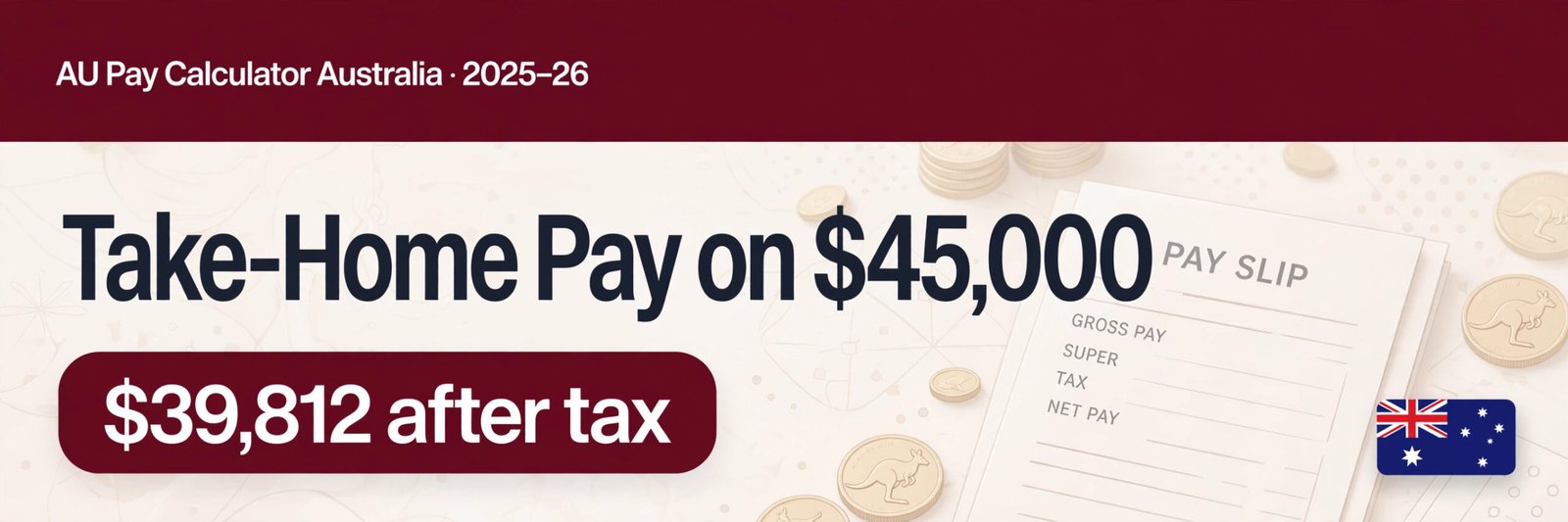
Earning $45,000 a year in Australia in the 2025–26 financial year? After tax and Medicare, your take-home pay is $39,812 a year — about $3,317.67 a month, $1,531.23 a fortnight or $765.62 a week. You pay $4,288 in income tax plus $900 in Medicare levy, an effective tax rate of just 11.5%.
$45,000 sits right on the boundary of two tax brackets, which makes it one of the more interesting salaries to understand. Here is the full breakdown, what happens if you get a small pay rise, and how the Low Income Tax Offset could lift your refund further.
The Full Breakdown: $45,000 in 2025–26
| Component | Amount |
|---|---|
| Gross salary | $45,000.00 |
| Income tax (2025–26 rates) | −$4,288.00 |
| Medicare levy (2%) | −$900.00 |
| Total deductions | −$5,188.00 |
| Take-home pay | $39,812.00 |
| Effective tax rate | 11.5% |
| Marginal tax rate | 16% (18% with Medicare) |
| Employer super (12%) | $5,400.00 |
How the Tax Is Calculated
Resident rates for 2025–26: the first $18,200 is tax-free, then 16c in the dollar to $45,000. Your entire taxable slice falls inside the 16% bracket:
| Income slice | Rate | Tax on this slice |
|---|---|---|
| $0 – $18,200 | 0% (tax-free threshold) | $0 |
| $18,201 – $45,000 | 16% | $4,288 |
| Total income tax | $4,288 |
Add the 2% Medicare levy ($900), and you arrive at $39,812. Because $45,000 is exactly the top of the 16% bracket, a $1 pay rise changes your marginal rate to 30% (32% with Medicare) — but only on the dollars above $45,000. Earning $46,000 costs you just $320 more in tax, not a scary cliff. Verify with the $45,000 salary breakdown or the free income tax calculator.
Take-Home Pay by Period
| Period | Gross | Tax + Medicare | Take-home |
|---|---|---|---|
| Annual | $45,000.00 | $5,188.00 | $39,812.00 |
| Monthly | $3,750.00 | $432.33 | $3,317.67 |
| Fortnightly | $1,730.77 | $199.54 | $1,531.23 |
| Weekly | $865.38 | $99.77 | $765.62 |
| Hourly (38-hour week) | $22.77 | $2.63 | $20.15 |
The Low Income Tax Offset: A Refund Bonus
The figures above are what PAYG withholding produces during the year, but at tax time you may get more back. The Low Income Tax Offset (LITO) gives a maximum of $700 to workers earning $37,500 or less, phasing down to $325 at incomes between $45,001 and $66,666. On $45,000, you are eligible for up to $325 in LITO — claimed automatically when you lodge your return, no separate application needed.
LITO cannot turn your tax bill negative, but it can reduce it to zero. Combined with work deductions, many $45,000 earners finish the year with a tidy refund. If you lodge yourself, the deadline is 31 October; through a registered tax agent you have until 15 May.
$45,000 vs a Small Pay Rise: The 30% Boundary
| Salary | Income tax | Medicare | Take-home | Marginal rate |
|---|---|---|---|---|
| $40,000 | $3,488 | $800 | $35,712 | 16% + 2% |
| $45,000 | $4,288 | $900 | $39,812 | 16% + 2% |
| $50,000 | $5,788 | $1,000 | $43,212 | 30% + 2% |
| $55,000 | $7,288 | $1,100 | $46,612 | 30% + 2% |
Crossing into the 30% bracket at $45,001 is nothing to fear: only the amount above $45,000 is taxed at the higher rate. A $5,000 rise to $50,000 still delivers $3,400 extra take-home — always worth taking.
Stretching $39,812: Practical Tips
- Check your withholding: If you work two jobs or earn side income, your PAYG withholding may be off. The gross to net calculator shows exactly what each payslip should look like.
- Track deductions from day one: Work expenses, union fees, home-office hours and charitable donations all reduce taxable income — at 16–30%, they are worth real money. Keep receipts.
- HECS debt holders: On $45,000 in 2025–26 you are below the $67,000 compulsory repayment threshold, so no HECS withholding comes off your pay. A pay rise past $67,000 changes that — see the HECS calculator.
- Super still builds: Your employer pays $5,400 a year into super on top of your wage. Small now, compounding later — check your fund’s fees are not eating it.
Is $45,000 Enough to Live On in Australia in 2026?
$39,812 of take-home pay is $3,318 a month, and whether that is enough depends almost entirely on housing. A realistic single-person budget in a capital city looks like this:
| Expense | Typical monthly cost |
|---|---|
| Rent (room in share house / outer studio) | $1,000 – $1,600 |
| Groceries | $350 – $450 |
| Transport | $150 – $300 |
| Utilities, phone, internet (share) | $120 – $200 |
| Everything else | $300 – $500 |
| Remaining | $200 – $900 |
It is survivable — millions of Australians live well on this income — but there is little margin for error, and building savings requires discipline. The biggest lever is housing: a share house versus a solo rental can be the difference between saving $500 a month and saving nothing. In regional areas, where rents run 30–50% lower than the capitals, $45,000 stretches considerably further.
Growing Your Income Past $45,000
Because $45,000 sits at the top of the 16% bracket, small income increases here are unusually rewarding: each extra dollar up to $135,000 is taxed at just 30% plus Medicare, so a $5,000 raise still delivers $3,400 in hand. Practical paths upward include:
- Overtime and penalty rates: Weekend and public-holiday shifts can add thousands a year at penalty rates. Check what your award pays with the overtime calculator and shift penalty calculator.
- Casual loading: Switching from part-time to casual at the same base rate adds a 25% loading — worth modelling with the casual loading calculator before you decide.
- A second income stream: Freelance or gig income is taxed at your marginal rate, but on $45,000 that is only 16–30% — side earnings keep most of their value.
- Upskilling into the next bracket: The jump from $45,000 to $60,000–$70,000 is where take-home pay starts to breathe ($52,412–$62,252 after tax). Short courses in trades, tech or healthcare routinely deliver this step.
Whatever path you take, remember the LITO phases out as income rises — but the offset you lose is always smaller than the extra take-home you gain. Earning more never leaves you worse off.
Salary Packaging on $45,000: Worth It?
At a 16% marginal rate, salary packaging delivers smaller wins than at higher incomes — sacrificing into super saves only the 1% gap between your 16% rate and the 15% contributions tax (plus the 2% Medicare saving). The maths improves sharply once you cross $45,001 into the 30% bracket, where each sacrificed dollar saves 17 cents. If your employer offers packaging for things you would buy anyway (a novated lease, extra super, a laptop), it is still worth doing — just run the salary sacrifice calculator first so you know the real saving rather than the brochure version.
Emergency Funds and the $45,000 Safety Net
On a tight income, an emergency fund matters more, not less. Aim for $2,000–$3,000 as a starter buffer (one month of essential expenses), kept in a separate high-interest savings account you do not touch. Without it, a single car repair or dental bill becomes credit-card debt at 20% interest — the fastest way to undo a year’s careful budgeting. Build it with automatic transfers on payday: even $50 a fortnight gets you to $1,300 in a year, and the habit matters more than the amount.
FAQ
How much tax do I pay on $45,000 in Australia in 2025-26?
$4,288 in income tax plus $900 in Medicare levy — $5,188 total. Your take-home pay is $39,812 a year.
What is $45,000 a month after tax?
$3,317.67 per month after tax and Medicare, assuming standard PAYG withholding with no HECS debt or deductions.
Do I get the Low Income Tax Offset on $45,000?
Yes — up to $325 in 2025–26. It is applied automatically when you lodge your tax return and may increase your refund.
What happens to my tax if my pay rises to $50,000?
Your marginal rate rises from 16% to 30% (plus 2% Medicare), but only on the dollars above $45,000. Your take-home still rises by about $3,400 a year.
Do I pay HECS repayments on $45,000?
No compulsory repayments in 2025–26 — the threshold is $67,000. You can still make voluntary repayments if you want to clear the debt faster.
How much super do I get on $45,000?
At the 12% Superannuation Guarantee rate, your employer contributes $5,400 a year on top of your salary — it is not deducted from your pay.
Can I salary package on $45,000?
Yes, but the savings are modest at a 16% marginal rate — they improve sharply once you cross $45,001 into the 30% bracket. Run your numbers in the salary sacrifice calculator before signing anything.
Is $45,000 taxed at 16%?
Only the slice between $18,201 and $45,000 is taxed at 16% — the first $18,200 is completely tax-free. That is why your effective rate including the 2% Medicare levy is just 11.5%, far below the headline marginal rate of 18%.
What is $45,000 a week after tax?
$765.62 a week after tax and Medicare, or $1,531.23 a fortnight — the figures most employers actually pay against on a standard full-time cycle.
Conclusion
$45,000 in 2025–26 means $39,812 in hand — a gentle 11.5% effective rate, a marginal rate that sits at the friendliest end of the scale, and up to $325 of LITO waiting at tax time. You are perched right on the edge of the 30% bracket, so every small rise still pays off handsomely. Confirm your payslip maths with the $45,000 after-tax breakdown and the gross to net pay calculator before you plan your budget.