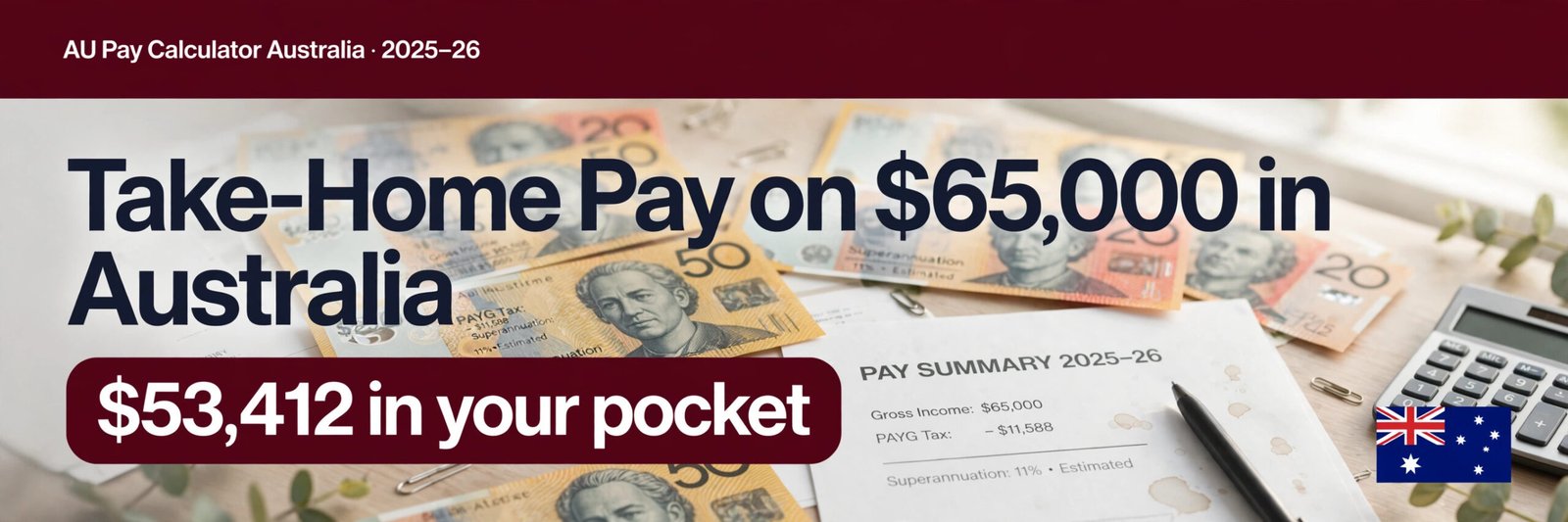
In the 2025-26 financial year, $65,000 take home pay in Australia is $53,412 a year — or $1,027.15 a week — after $10,288 of income tax and a $1,300 Medicare levy. That is $11,588 in total tax, an effective tax rate of 17.83%.
Your marginal rate is 32%, so every extra dollar is taxed at 32 cents until the next bracket. Your employer also pays $7,800 a year in super, and a HECS or HELP debt triggers no compulsory repayments — $65,000 sits just below the 2025-26 threshold of $67,000. Below: where every dollar goes, your take-home each pay cycle, how the tax is calculated, and what a rise to $70,000 is really worth. All figures use the 2025-26 resident rates and the 2% Medicare levy, before offsets.
Your $65,000 Salary: The Annual Breakdown
Here is the full picture for a single Australian resident earning $65,000 in 2025-26, with no HECS repayment and no salary sacrifice or other deductions.
| Item | Amount |
|---|---|
| Gross annual salary | $65,000 |
| Income tax | −$10,288 |
| Medicare levy (2%) | −$1,300 |
| Total tax | −$11,588 |
| Take-home pay | $53,412 |
| Effective tax rate | 17.83% |
| Marginal tax rate | 32% (30% tax + 2% levy) |
The gap between the two rates catches a lot of people out. Your effective tax rate of 17.83% is the average across your whole income — total tax divided by $65,000 — while your marginal rate of 32% applies only to your next dollar. The first $18,200 is tax-free and the slice to $45,000 is taxed at only 16%, which drags the average well below the rate on your top dollars. That is also why a pay rise never leaves you worse off: only income inside a higher bracket is taxed at the higher rate.
These figures are before offsets: the Low Income Tax Offset has not been applied, so the numbers line up exactly with the site’s calculator. If you qualify for offsets, your tax bill could be lower, with the difference refunded at tax time. Check your own numbers with the income tax calculator or the $65,000 salary page.
Take-Home Pay by Pay Cycle: Weekly, Fortnightly and Monthly
Annual figures suit tax time, but most of us budget by pay cycle — here is what $65,000 works out to each payday.
| Pay cycle | Gross pay | Tax and levy | Take-home pay |
|---|---|---|---|
| Weekly | $1,250.00 | $222.85 | $1,027.15 |
| Fortnightly | $2,500.00 | $445.69 | $2,054.31 |
| Monthly | $5,416.67 | $965.67 | $4,451.00 |
| Annual | $65,000.00 | $11,588.00 | $53,412.00 |
The weekly figure is the one most people remember: $1,027.15 a week from a $1,250 gross week. Fortnightly, expect $2,054.31 each payday; monthly, $4,451.00. Small rounding differences can appear between pay cycles, but the yearly totals reconcile to the same $53,412.
Your hourly equivalent is also worth knowing. On a standard 38-hour week, $65,000 a year works out to $32.89 an hour before tax — a handy benchmark for comparing a salaried offer against an hourly role.
How the $10,288 Tax Is Calculated, Step by Step
Australia’s 2025-26 resident rates are progressive: income is taxed in slices, each at a different rate.
| Taxable income | Tax on this slice |
|---|---|
| $0 – $18,200 | Nil |
| $18,201 – $45,000 | 16% on the amount over $18,200 |
| $45,001 – $135,000 | $4,288 plus 30% on the amount over $45,000 |
| $135,001 – $190,000 | $31,288 plus 37% on the amount over $135,000 |
| Over $190,000 | $51,638 plus 45% on the amount over $190,000 |
Apply those brackets to $65,000, one slice at a time:
- Tax-free threshold — $0. The first $18,200 is not taxed at all. This is the biggest reason your effective rate is so much lower than your marginal rate.
- $18,201 to $45,000 — $4,288. This $26,800 slice is taxed at 16%: $26,800 × 16% = $4,288.
- $45,001 to $65,000 — $6,000. The remaining $20,000 falls in the 30% bracket: $20,000 × 30% = $6,000.
- Income tax: $4,288 + $6,000 = $10,288.
- Medicare levy: 2% × $65,000 = $1,300. The levy is charged on your full taxable income, although low-income earners can qualify for a reduction.
- Total tax: $10,288 + $1,300 = $11,588. Subtract that from $65,000 and you get $53,412 in take-home pay.
Knowing which bracket your next dollar falls in tells you exactly how much of it you keep. One forward-looking note: the 16% band falls to 15% from 1 July 2026, the start of the 2026-27 financial year. That change does not affect the 2025-26 figures in this article.
What a Pay Rise to $70,000 Would Be Worth
A $5,000 pay rise sounds like $5,000 more in your pocket. It is not — but it is still worth having. The extra $5,000 sits entirely in the 30% bracket, so the tax on it is straightforward.
| Item | On $65,000 | On $70,000 | Difference |
|---|---|---|---|
| Gross salary | $65,000 | $70,000 | +$5,000 |
| Income tax | $10,288 | $11,788 | +$1,500 |
| Medicare levy | $1,300 | $1,400 | +$100 |
| Total tax | $11,588 | $13,188 | +$1,600 |
| Take-home pay | $53,412 | $56,812 | +$3,400 |
The maths: extra tax is 30% × $5,000 = $1,500, plus 2% × $5,000 = $100 in extra Medicare levy — $1,600 in total. That leaves $3,400 of the $5,000 reaching you, 68 cents in every extra dollar. Weekly, take-home rises from $1,027.15 to about $1,092.54, an extra $65.38 a week.
Use this number in a salary negotiation. Weighing a $5,000 raise against a non-cash benefit? Compare the benefit against $3,400 of extra after-tax cash, not $5,000. Model any raise with the pay rise calculator. And remember: a pay rise cannot leave you worse off, because only the income above each threshold is taxed at the higher rate.
Superannuation on $65,000: $7,800 a Year on Top
Superannuation never appears on your payslip as take-home pay, but it is real money. In 2025-26 the Superannuation Guarantee rate is 12%, paid by your employer on top of your salary: on $65,000 that is $7,800 a year — $650 a month, about $150 a week — so your total package is $72,800. A contract role at the same headline rate without super is worth $7,800 a year less.
Super is taxed differently from salary: employer contributions are generally taxed at 15% inside the fund, rather than at your marginal rate, which is one reason salary sacrificing extra money into super can be attractive once your budget is under control. The trade-off is that super is preserved until retirement. Check contributions appear on your payslip and in your fund — generally due quarterly — and that you are not paying duplicate insurance across funds from past jobs. Estimate the long-term effect of contributions at your salary with the super calculator.
HECS and HELP: Nothing to Repay at $65,000
If you have a HECS or HELP loan, your salary decides whether you make compulsory repayments — at $65,000, the answer is none. The 2025-26 threshold is $67,000, and $65,000 sits $2,000 below it, so your compulsory HECS repayment is $0.
That $2,000 gap matters. A rise to $70,000 would push you over the threshold, where repayments are marginal: 15% on income above $67,000. On $70,000, the repayment on the $3,000 above the threshold would be 15% × $3,000 = $450 a year, on top of the extra income tax and Medicare levy. Repayments are collected through the tax system and reduce your loan balance rather than disappearing as tax, and if your employer withholds for a HELP debt while your income stays below the threshold, the amount is refunded at tax time. It is not a reason to turn down a pay rise — you still come out ahead — but budget for the extra deduction rather than being surprised by it.
Budgeting on $53,412 Take-Home Pay
Knowing your take-home pay is only half the job. On $53,412 a year after tax, you have $4,451.00 a month to work with. A simple starting point is the 50/30/20 rule: roughly half for needs, 30% for wants, 20% for savings and extra debt repayments.
| Category | Share | Monthly amount |
|---|---|---|
| Needs — rent, bills, groceries, transport | 50% | $2,225.50 |
| Wants — eating out, entertainment, holidays | 30% | $1,335.30 |
| Savings and extra debt repayments | 20% | $890.20 |
That split is a guide, not a law. In Sydney or Melbourne, rent alone can swallow far more than half of a $4,451 monthly income — the point is to have a plan rather than to hit the numbers exactly. What matters is that savings is a fixed habit, not whatever is left over at month’s end. An automatic transfer of $890.20, or whatever you can manage, on payday is the most reliable way to build an emergency fund. Three months of essential spending is a solid first target: roughly $6,700, or about seven and a half months of saving $890.20 a month.
Review the deductions you can control, too. Salary sacrifice into super, work-related deductions, and the Medicare levy reduction or any offsets can all change your end-of-year tax outcome, even though they do not change the $1,027.15 that lands each week. Keep receipts for work-related expenses throughout the year, and if your circumstances change — a side income, a move, or a second job — re-check your withholding so you are not hit with a bill in July.
Frequently Asked Questions
How much is $65,000 after tax in Australia?
In 2025-26, $65,000 leaves $53,412 after tax: $10,288 income tax plus a $1,300 Medicare levy, $11,588 in total. Weekly take-home is $1,027.15, fortnightly $2,054.31, monthly $4,451.00. These figures are before offsets — if you qualify for the Low Income Tax Offset, your final bill could be lower, with the difference refunded at tax time.
What is the weekly take-home pay on $65,000?
Your weekly take-home pay on $65,000 is $1,027.15, from a gross weekly wage of $1,250.00. Tax and the Medicare levy take $222.85 a week. That assumes 52 weekly pays with no overtime, bonuses or extra deductions; overtime and bonuses are taxed in the pay period received, so individual payslips can vary.
What tax rate do I pay on $65,000?
Your marginal rate is 32% — 30% income tax plus the 2% Medicare levy — the rate on your next dollar. Your effective rate, the average across your whole salary, is 17.83%, because the first $18,200 is tax-free and the slice to $45,000 is taxed at only 16%. Mixing the two rates up is the most common mistake people make when reading their payslip.
Do I pay HECS on a $65,000 salary?
No. The 2025-26 HECS/HELP threshold is $67,000 and $65,000 is below it, so you owe nothing in compulsory repayments. Above $67,000, repayments apply at a marginal 15% on the income above the threshold. If your employer withheld extra tax for a HELP debt while your income stayed below it, the amount is refunded at tax time.
How much super do I get on $65,000?
Your employer pays 12% into super in 2025-26 — $7,800 a year, or $650 a month, on $65,000 — on top of your salary, so your total package is $72,800. Contributions are taxed at 15% inside the fund, not at your marginal rate, which is why extra voluntary contributions can be tax-effective.
Is $65,000 a good salary in Australia?
It depends on where you live. Outside the most expensive capital cities, $4,451 a month after tax can cover rent, bills and a modest lifestyle with room to save; in Sydney or Melbourne, housing takes a much larger share. The national minimum wage is $26.44 an hour from 1 July 2026, about $52,234 a year full-time, so $65,000 sits comfortably above the minimum. Whether it feels good comes down to your rent, debts, and how much of the 50/30/20 split you can hold to.
Conclusion
On $65,000 in 2025-26, you keep $53,412 — $1,027.15 a week, $2,054.31 a fortnight, $4,451.00 a month — after $10,288 income tax and a $1,300 Medicare levy. Your effective rate is 17.83%, your marginal rate 32%, your employer adds $7,800 a year in super, and you owe no compulsory HECS repayment below the $67,000 threshold. A $5,000 rise to $70,000 would put an extra $3,400 a year in your pocket — know that figure before you negotiate.
If your salary is different, or you want to test a pay rise, a HECS scenario, or salary sacrifice, run the numbers yourself. The gross to net calculator gives the same breakdown for any salary in seconds, and the income tax calculator shows the tax on each slice. Check your figures before your next pay review — five minutes now is the cheapest pay rise you will ever get.