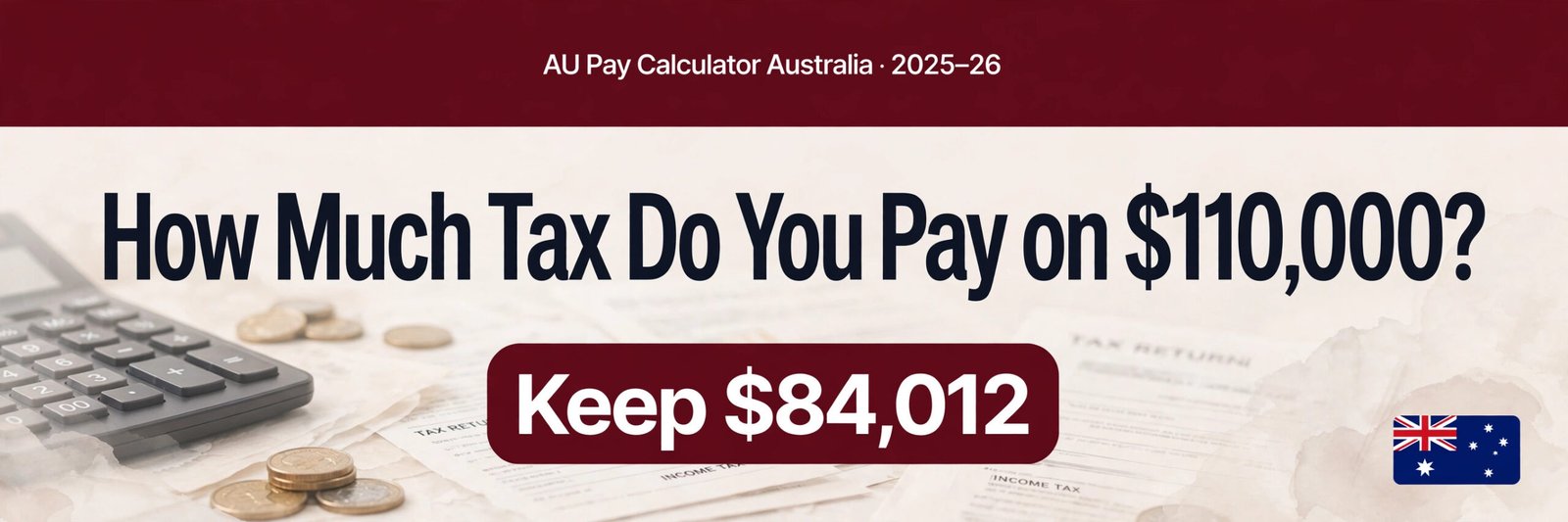
On a salary of $110,000 in Australia in 2025–26, you pay $23,788 in income tax plus a $2,200 Medicare levy, a total of $25,988. That leaves take-home pay of $84,012 a year, or $1,615.62 a week. Your effective tax rate is 23.6%, well below your marginal rate of 30%, because Australia’s progressive system taxes each slice of your income at a different rate.
To check your own numbers, including any salary sacrifice or HECS repayments, use the income tax calculator. This guide works through the bracket-by-bracket calculation, shows what you keep each pay period, and explains how extra income, deductions and the 2026–27 rate change affect the result.
How the $23,788 income tax is calculated
Australian residents pay tax at progressive rates, so only the part of your income inside each bracket is taxed at that bracket’s rate. The 2025–26 resident rates are: 0% up to $18,200, 16% from $18,201 to $45,000, 30% from $45,001 to $135,000, 37% from $135,001 to $190,000, and 45% above $190,000. A $110,000 salary sits entirely within the first three brackets, so the calculation is straightforward.
| Income slice | Rate | Tax on this slice |
|---|---|---|
| $0 – $18,200 | 0% | $0 |
| $18,201 – $45,000 ($26,800) | 16% | $4,288 |
| $45,001 – $110,000 ($65,000) | 30% | $19,500 |
| Total income tax | $23,788 |
On top of income tax, most workers pay the Medicare levy of 2% of taxable income, which on $110,000 is $2,200. That brings total deductions to $25,988 and take-home pay to $84,012. If you earn above the Medicare levy surcharge thresholds and hold no private hospital cover, a surcharge of 1% to 1.5% may also apply, but for most people on $110,000 the levy alone is the relevant figure.
What you keep each pay period
Employers withhold tax from each pay, so your payslip should roughly match these figures if you claim the tax-free threshold and have no other adjustments. Small differences arise from rounding and from the way PAYG withholding tables annualise each pay.
| Pay period | Gross pay | Take-home pay |
|---|---|---|
| Weekly | $2,115.38 | $1,615.62 |
| Fortnightly | $4,230.77 | $3,231.23 |
| Monthly | $9,166.67 | $7,001.00 |
| Annual | $110,000 | $84,012 |
Your employer also pays superannuation on top of your salary. At the 12% superannuation guarantee rate, that is $13,200 a year into your super fund, taking your total package to $123,200 before tax. Super is not part of your take-home pay, but it is part of what your job is worth, and it matters when comparing offers.
Your marginal rate is 30% — and why that matters
Your marginal tax rate is the rate on your next dollar of income. On $110,000, every extra dollar up to $135,000 is taxed at 30% plus the 2% Medicare levy, so you keep 68 cents of each additional dollar. This is the rate that matters for decisions about overtime, a bonus, a pay rise or salary sacrifice.
For example, a $5,000 bonus on top of a $110,000 salary costs $1,600 in extra tax and Medicare levy, leaving $3,400. A $5,000 salary sacrifice contribution into super, by contrast, avoids the 30% marginal rate and is instead taxed at 15% inside the fund, saving roughly $750 in tax while boosting your retirement balance. Run the numbers on the salary sacrifice calculator before committing, and check the $30,000 concessional contributions cap.
It is also worth knowing what happens if your income grows. The 30% bracket runs to $135,000, so there is $25,000 of headroom before the 37% rate begins. If your salary rises to $135,000, your tax bill becomes $31,288 plus a $2,700 Medicare levy, and take-home pay rises to $101,012. Crossing into the 37% bracket does not mean your whole income is taxed at 37% — only the slice above $135,000.
What can change your final tax bill
The $23,788 figure assumes you are an Australian resident for tax purposes for the full year, you claim the tax-free threshold, and you have no deductions, offsets or debts beyond the Medicare levy. Several things commonly change the outcome:
- Work-related deductions: tools, travel, home office costs and professional subscriptions reduce taxable income. Every $1,000 of deductions on a $110,000 salary saves about $320 in tax and Medicare levy.
- HECS-HELP repayments: these are withheld on top of tax. At $110,000, the 2025–26 marginal repayment rate means a significant extra withholding, but it pays down your student debt rather than going to general revenue.
- Private health insurance: holding hospital cover avoids the Medicare levy surcharge if your income exceeds the surcharge thresholds, and may attract the private health insurance rebate depending on your income tier.
- Salary sacrifice and reportable fringe benefits: these change both taxable income and the income used for surcharge and HECS calculations, so check the interaction before making changes.
- Investment income or losses: dividends, interest, rental income and capital gains are added to your salary and taxed at your marginal rate, while deductible losses can reduce taxable income.
One more change to note: from 1 July 2026, the 16% rate drops to 15% for the 2026–27 year. On a $110,000 income that saves $268 a year, since the $26,800 slice in the second bracket is taxed at 15% instead of 16%. If you are budgeting for the 2026–27 year, your income tax would be $23,520 rather than $23,788.
How $110,000 compares with nearby salaries
Context helps when judging whether a $110,000 offer is competitive. Compared with a $95,000 salary, which keeps $73,812 after tax and Medicare levy, $110,000 keeps $10,200 more — you keep 68 cents of each extra dollar between the two salaries. Compared with $130,000, which keeps $97,612, the gap is $13,600 of extra take-home pay for $20,000 of extra salary.
For a full breakdown of nearby incomes, see our guides to take-home pay on $95,000 and take-home pay on $130,000, or model any figure with the income tax calculator.
How to reduce tax on $110,000 legally
There is no magic way to make tax disappear, but several legitimate strategies reduce taxable income at a 30% marginal rate, where each $1,000 saved is worth about $320. The most widely used is salary sacrifice into super: contributions up to the $30,000 concessional cap are taxed at 15% inside the fund instead of 30% plus Medicare levy, so a $10,000 sacrifice saves roughly $1,500 in tax while adding to your retirement balance. The trade-off is access — the money is preserved until you meet a condition of release — so it suits people with comfortable cash flow rather than anyone living pay to pay.
Work-related deductions are the second lever, and the one most people under-claim. If you buy tools, pay for professional development, travel between work sites, or work from home, those costs may be deductible. Keep receipts and a simple log through the year; reconstructing expenses in June is where deductions get lost. The ATO’s fixed-rate method for working from home is 70 cents per hour for the 2025–26 year, covering energy, internet, phone and stationery, but you cannot also claim the same expenses separately, so compare the methods before choosing.
Timing matters too. If you expect a lower-income year — parental leave, study, or a career break — bringing deductions forward or deferring income can shift tax into a lower bracket. Conversely, if a bonus is likely, making a deductible super contribution in the same year can offset the extra tax. These moves are worth discussing with a registered tax agent, especially once reportable super contributions start affecting HECS repayments or family assistance. Small, legal adjustments at a 30% marginal rate add up: $5,000 of deductions or concessional contributions saves around $1,500 to $1,600 a year, every year.
Frequently asked questions
How much tax do I pay on $110,000 in Australia?
In 2025–26, you pay $23,788 in income tax plus a $2,200 Medicare levy, for a total of $25,988. Your take-home pay is $84,012 a year, or $1,615.62 a week.
What is the tax rate on $110,000?
Your marginal rate is 30%, but your effective rate is 23.6% once the tax-free threshold and lower brackets are counted. Only income above $45,000 is taxed at 30%, and only income above $135,000 reaches 37%.
How much is $110,000 a year per week after tax?
After income tax and the Medicare levy, $110,000 a year is $1,615.62 a week, $3,231.23 a fortnight and $7,001.00 a month.
Does the Medicare levy apply on top of income tax?
Yes. The Medicare levy is 2% of taxable income and is charged in addition to income tax. On $110,000 it is $2,200. Low-income earners may pay a reduced levy or none at all.
How much tax is taken from a $110,000 bonus?
A bonus is taxed at your marginal rate, not a special bonus rate. A $5,000 bonus on a $110,000 salary attracts $1,500 in income tax plus $100 in Medicare levy, leaving $3,400, assuming no HECS or surcharge applies.
Will my tax change in 2026–27?
Yes, slightly. From 1 July 2026 the 16% bracket rate falls to 15%, saving $268 a year on a $110,000 income. All other 2025–26 brackets and thresholds stay the same for 2026–27.
Conclusion
On $110,000 in 2025–26, the numbers are clean: $23,788 in income tax, $2,200 in Medicare levy, and $84,012 in your pocket. The figure that matters most for your next decision is the 30% marginal rate — it tells you what a raise, a bonus or a salary sacrifice move is really worth. Model your exact situation, including HECS and deductions, with the income tax calculator, and revisit the calculation whenever your salary or circumstances change.