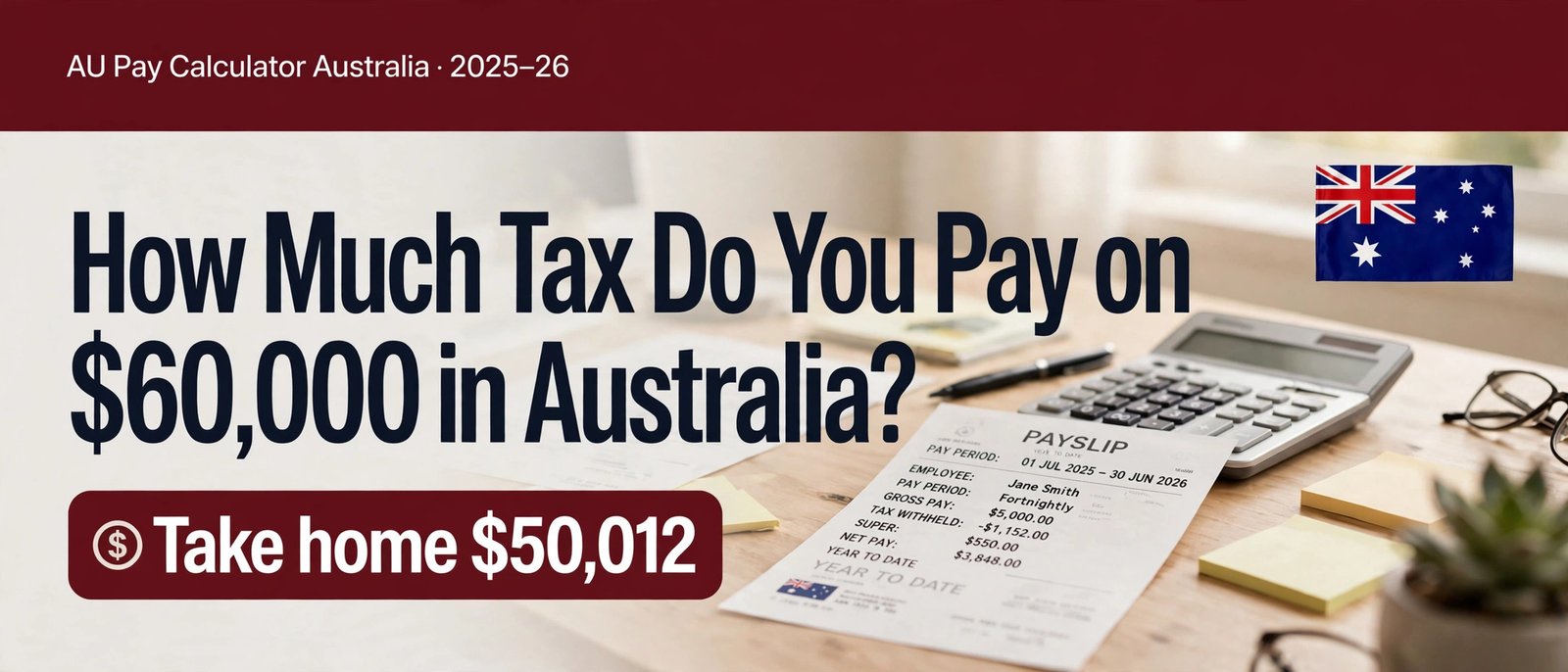
If you earn $60,000 a year in Australia in the 2025-26 financial year, you pay $8,788 in income tax plus a $1,200 Medicare levy — $9,988 in total — leaving you with $50,012 take-home pay. That is $961.77 a week in your pocket. This guide shows exactly how that figure is calculated, what you keep each week, fortnight and month, and what $60,000 means for superannuation, HECS and the Medicare Levy Surcharge. All figures are for Australian residents in 2025-26, before offsets, and they match the income tax calculator on this site.
Australia uses a progressive tax system, so your $60,000 is not taxed at one flat rate. The first $18,200 is tax-free, the next slice is taxed at 16%, and only the part above $45,000 is taxed at 30%, with the 2% Medicare levy added on top.
The short answer: tax on $60,000 in 2025-26
Here is the complete result in one table, before we break the maths down in detail.
| Item | Amount |
|---|---|
| Gross annual salary | $60,000 |
| Income tax (2025-26 resident rates) | $8,788 |
| Medicare levy (2% of taxable income) | $1,200 |
| Total tax and levy | $9,988 |
| Take-home pay | $50,012 |
| Effective tax rate | 16.65% |
| Marginal tax rate | 32% (30% tax + 2% levy) |
| Weekly take-home pay | $961.77 |
| Fortnightly take-home pay | $1,923.54 |
| Monthly take-home pay | $4,167.67 |
Your effective tax rate is 16.65% — your total tax of $9,988 divided by your gross salary of $60,000. That is the average rate across your whole income. Your marginal rate, explained below, is 32%.
These figures are calculated before offsets. No Low Income Tax Offset has been applied. The figures are income tax plus the 2% Medicare levy only, exactly as the site’s calculator works. If you are eligible for an offset, your actual tax payable at tax time could be lower.
How the $8,788 income tax is worked out, step by step
Under the 2025-26 resident tax brackets, different slices of your income are taxed at different rates. You never pay the top rate on your whole salary — only on the slice that falls into that bracket. For $60,000, only two brackets apply, plus the tax-free threshold.
| Taxable income bracket | Tax rate | Tax on this slice at $60,000 |
|---|---|---|
| $0 – $18,200 | Nil | $0 |
| $18,201 – $45,000 | 16% | $4,288 |
| $45,001 – $135,000 | 30% | $4,500 |
| $135,001 – $190,000 | 37% | Not reached at $60,000 |
| Over $190,000 | 45% | Not reached at $60,000 |
Here is the calculation in full. First, the tax-free threshold covers the first $18,200, so no tax is payable on that slice. Second, the slice from $18,201 to $45,000 is $26,800 wide; at 16%, the tax on that slice is $4,288. Third, the remaining slice from $45,001 to $60,000 is $15,000 wide; at 30%, the tax on that slice is $4,500. Add them together — $4,288 plus $4,500 — and you get $8,788 in income tax. There is no 37% or 45% tax at this income, because your salary does not reach those brackets.
The Medicare levy is added separately: 2% of $60,000 is $1,200. Your total tax and levy is therefore $8,788 plus $1,200, which is $9,988, leaving take-home pay of $50,012. If your taxable income is lower than your gross salary because you claim deductions, both the income tax and the levy would be calculated on that lower amount instead.
A brief note on next year: the 16% band falls to 15% from 1 July 2026. That change belongs to the 2026-27 year and does not affect the 2025-26 figures in this article.
Your take-home pay: weekly, fortnightly and monthly
Most people think in what lands in their bank account each pay, not in annual figures. The table below converts the $50,012 annual take-home figure into the pay cycles Australians actually use.
| Pay cycle | Gross pay | Take-home pay | Tax and levy withheld |
|---|---|---|---|
| Weekly (52 pays) | $1,153.85 | $961.77 | $192.08 |
| Fortnightly (26 pays) | $2,307.69 | $1,923.54 | $384.15 |
| Monthly (12 pays) | $5,000.00 | $4,167.67 | $832.33 |
| Annual | $60,000 | $50,012 | $9,988 |
On a weekly cycle you keep $961.77 out of $1,153.85 gross. On a fortnightly cycle, the most common pay cycle in Australia, you keep $1,923.54 out of $2,307.69. On a monthly cycle you keep $4,167.67 out of $5,000. Small rounding differences between cycles are normal, and the annual total is what your tax return reconciles. For a closer look at this salary, see the $60,000 salary page and the related guide on take-home pay on $60,000.
A pay rise does not push your whole salary into a higher rate. Only the extra dollars above $45,000 are taxed at 30% plus the 2% levy, up to $135,000. A $5,000 pay rise to $65,000, for example, would add $1,600 in tax and levy on that extra $5,000, leaving you $3,400 of it to keep.
What your marginal tax rate of 32% really means
Your marginal tax rate on $60,000 is 32%: 30% income tax plus the 2% Medicare levy. That is the rate that applies to every extra dollar you earn above $45,000, up to $135,000. It is not the rate you pay on all of your income. Your average, or effective, rate is only 16.65%, because the tax-free threshold and the 16% band shelter a large part of your pay. Confusing the two is one of the most common tax misunderstandings in Australia, and it leads some people to turn down overtime or a pay rise because they believe the extra income will be taxed away. It will not be. You keep 68 cents of every extra dollar in that range.
That 32% figure is the right number to use when weighing extra income. If you are offered overtime or freelance work, you can estimate the after-tax value by keeping roughly 68% of the extra gross pay. If you are considering salary sacrificing into superannuation, the comparison is against that same 32% rate. Use the income tax calculator to test any salary in that range.
Superannuation on $60,000: $7,200 a year from your employer
Superannuation is separate from your take-home pay. It is not deducted from your $60,000 salary, and it is not part of the $9,988 tax figure. Under the Superannuation Guarantee, your employer must pay super on top of your salary, at a rate of 12% in 2025-26. On a $60,000 salary that is $7,200 a year, or $600 a month, paid into your super fund. Your total package is therefore $67,200 a year — $60,000 in salary plus $7,200 in super — even though only the $60,000 appears as your gross pay.
That $7,200 is taxed inside your super fund at a concessional rate, not at your marginal rate, and it is preserved until retirement. Check that it is actually being paid: your payslip should show the super amount each pay. To model different salaries and contribution rates, use the super calculator.
HECS and HELP: no compulsory repayment at $60,000
If you have a HECS or HELP student loan, you pay no compulsory repayment on a $60,000 income in 2025-26. The minimum repayment threshold for 2025-26 is $67,000, and your income sits $7,000 below it. Your employer should therefore not be withholding extra amounts for HECS from your pay, and no repayment is included in the $9,988 total. Your loan balance still exists and is indexed each year, but no repayment is due until your income reaches the threshold.
Above $67,000, repayments are marginal: 15% on income from $67,001 to $125,000. Crossing the threshold does not suddenly cost you a large share of your pay — only the income above $67,000 is subject to the 15% rate in that band. Check your own position with the HECS calculator.
Medicare levy and Medicare Levy Surcharge
The Medicare levy is the 2% charge already included in your total: $1,200 on $60,000. Almost all Australian residents pay it, and it helps fund Medicare. It is separate from income tax, which is why it is shown on its own line in the tables above, but for your take-home pay the two are combined into the $9,988 total. If your taxable income were lower because of deductions, the levy would also be lower, because it is 2% of taxable income.
The Medicare Levy Surcharge is a different charge, and you do not pay it at this income. The surcharge only applies to higher-income earners without an appropriate level of private hospital cover. In 2025-26, singles earning $101,000 or less pay no surcharge, so at $60,000 there is nothing to pay and no hospital cover is required to avoid it. Do not buy private hospital cover just to avoid the surcharge at this salary, because there is no surcharge to avoid.
What $60,000 works out to per hour
On a standard 38-hour week, a $60,000 annual salary works out to $30.34 an hour gross, before tax. Your after-tax hourly rate is lower, at about $25.31 an hour, because the $9,988 in tax and levy is spread across the same hours. The gross figure is the useful one for comparing a salary with an hourly job offer, while the after-tax figure is the useful one for budgeting, because it is what your time actually puts in your pocket.
When you compare a salaried role with a casual role, remember the salary usually comes with paid leave and superannuation, while a casual rate usually includes a loading in place of leave. Weigh leave, job security and super before deciding which offer is genuinely better.
Frequently asked questions
How much tax do I pay on $60,000 in Australia?
In 2025-26, you pay $8,788 in income tax plus a $1,200 Medicare levy on $60,000, for a total of $9,988. Your take-home pay is $50,012 a year. These figures are for an Australian resident, before offsets, with no deductions claimed.
What is my take-home pay on $60,000 a week?
Your weekly take-home pay is $961.77, from a weekly gross of $1,153.85. Fortnightly, you take home $1,923.54, and monthly you take home $4,167.67. The difference between gross and take-home pay is the tax and Medicare levy withheld each pay.
What is the tax rate on $60,000 in Australia?
There is no single rate. Your effective tax rate is 16.65%, which is your total tax of $9,988 divided by $60,000. Your marginal tax rate is 32%, which is the 30% income tax rate plus the 2% Medicare levy that applies to each extra dollar above $45,000, up to $135,000.
Do I pay HECS on $60,000?
No. In 2025-26, the minimum HECS and HELP repayment threshold is $67,000, so a $60,000 income is below the threshold and no compulsory repayment is due. Above $67,000, repayments are marginal at 15% on income from $67,001 to $125,000.
Do I pay the Medicare Levy Surcharge on $60,000?
No. In 2025-26, singles earning $101,000 or less pay no Medicare Levy Surcharge. You still pay the ordinary 2% Medicare levy of $1,200, but there is no surcharge to pay and no private hospital cover is required to avoid it at this income.
How much super do I get on $60,000?
Your employer pays 12% of your salary as superannuation on top of your pay, which is $7,200 a year or $600 a month on $60,000. It is paid into your super fund, not into your take-home pay, so your total package is $67,200 a year.
Conclusion
On $60,000 in Australia in 2025-26, the numbers are straightforward: $8,788 in income tax, $1,200 in Medicare levy, $9,988 in total, and $50,012 left as take-home pay. That is $961.77 a week, $1,923.54 a fortnight and $4,167.67 a month, with an effective tax rate of 16.65% and a marginal rate of 32% on every extra dollar above $45,000. There is no HECS repayment and no Medicare Levy Surcharge at this income, and your employer adds $7,200 in superannuation on top. To test a different salary or a pay rise, run the numbers through the income tax calculator.