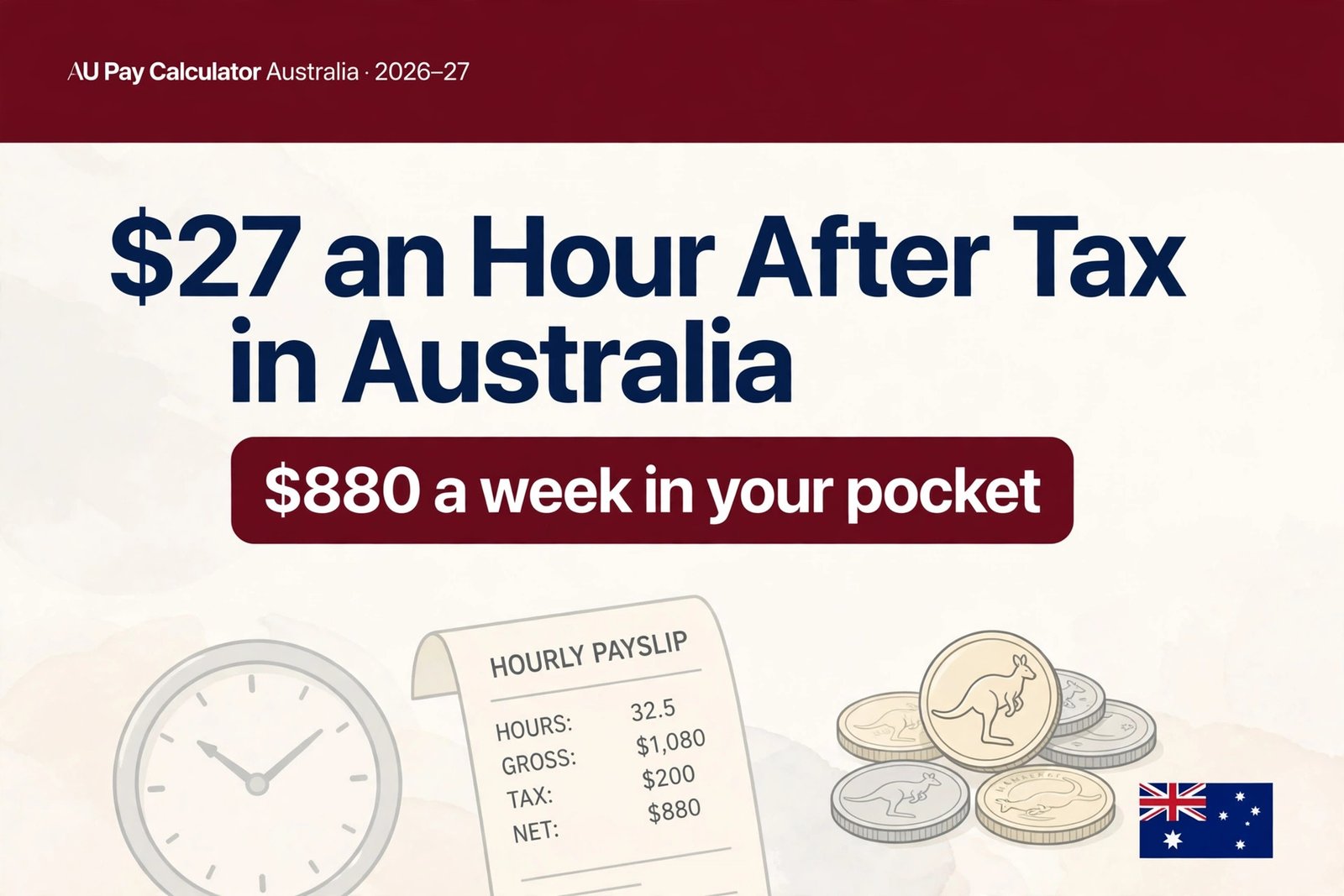
If you earn $27 an hour in Australia, your pay sounds straightforward — until tax and the Medicare levy take their share. On a standard full-time week of 38 hours, $27 an hour is $53,352 a year before tax, or $1,026 a week gross. After income tax and the 2% Medicare levy, you keep $45,759 a year, which is $879.98 a week in your pocket, or an after-tax hourly rate of $23.16. All figures use the legislated 2026–27 resident tax rates, including the second-bracket cut from 16% to 15%, and no Low Income Tax Offset — the site calculator does not apply LITO, so these figures match what our calculator will show you.
That matters because $27 an hour sits very close to the legal floor. The national minimum wage from 1 July 2026 is $26.44 an hour, or $1,004.90 a week for a 38-hour week. At $27 you are only $0.56 an hour above the minimum wage — about $21.28 a week more than a minimum-wage worker on the same hours. It is essentially a minimum-wage-plus job: a fair starting point in retail, hospitality, warehousing, cleaning and aged care support, but not a rate with much room for error.
What Is $27 an Hour After Tax in 2026–27?
On $27 an hour for 38 hours a week, 52 weeks a year, your gross pay is $53,352 a year. From that you pay $6,526 in income tax and $1,067 in Medicare levy — total deductions of $7,593 — leaving $45,759 a year in take-home pay.
| Item | Amount |
|---|---|
| Hourly rate (gross) | $27.00 |
| Gross pay per week (38 hours) | $1,026.00 |
| Gross pay per month | $4,446.00 |
| Gross pay per year | $53,352.00 |
| Income tax | −$6,526.00 |
| Medicare levy (2%) | −$1,067.00 |
| Take-home pay | $45,759.00 per year |
| Take-home per month / fortnight / week | $3,813.25 / $1,759.96 / $879.98 |
| After-tax hourly rate (38-hour week) | $23.16 |
The weekly figure is the one most people live by: $879.98 a week after tax, or $1,759.96 each fortnight. Your monthly take-home of $3,813.25 is the number to use for rent, bills and direct debits. Check your own hours with our income tax calculator and our $27 an hour page.
How the $6,526 income tax is calculated
The 2026–27 resident brackets are: $0–$18,200 nil; $18,201–$45,000 at 15%; $45,001–$135,000 at 30% ($4,020 plus 30 cents per dollar over $45,000); $135,001–$190,000 at 37%; and $190,001 and over at 45%. On $53,352, the first $18,200 is tax-free, the $26,800 from $18,201 to $45,000 is taxed at 15% ($4,020), and the remaining $8,352 is taxed at 30% ($2,505.60) — $6,525.60 in total, rounded to $6,526. The Medicare levy is a flat 2%: 2% of $53,352 is $1,067.04, rounded to $1,067. Your total deductions are $7,593, about 14.2% of gross pay, so you keep about 85.8 cents in every dollar.
In 2025–26 the second bracket was 16%, so the same $53,352 attracted $6,794 in income tax — $268 more. The 2026–27 cut to 15% saves you $268 a year, and it is already reflected in the $45,759 take-home figure. This article does not apply LITO, because the site calculator does not use it.
Your marginal tax rate on $27 an hour
Your marginal tax rate on $53,352 is 30%, or 32% including the 2% Medicare levy. Every extra dollar above $45,000 keeps about 68 cents, so a $1,000 pay rise is worth about $680 after tax. A $2-an-hour rise to $29 an hour is worth about $2,688 a year extra in take-home pay.
HECS-HELP and superannuation
In 2026–27 the HECS-HELP repayment threshold is $69,528, with a marginal rate of 15% of income over that threshold up to $129,717. At $53,352 you are $16,176 below the threshold, so your HECS repayment is $0 and your take-home of $45,759 is not reduced by a student debt. The position changes if overtime or a second job pushes your total income over $69,528 — then a repayment applies on the amount above the threshold. Model your own position with our HECS calculator.
Super is paid on top of your salary, so it does not reduce take-home pay. In 2026–27 the Superannuation Guarantee rate is 12%, so on $53,352 your employer contributes $6,402.24 a year — $123.12 a week, or about $533.52 a month. Your total package is therefore $59,754.24 a year. Check that super is actually being paid, especially in casual or short-term roles: $123 a week compounds into a very large sum over a working life.
$27 an Hour Compared With the Minimum Wage and Nearby Rates
The national minimum wage is $26.44 an hour from 1 July 2026 — $1,004.90 a week for 38 hours, or $52,254.80 a year. At $27 you earn $0.56 an hour more, $21.28 a week more, and $1,097.20 a year more in gross pay than a minimum-wage worker. After tax, the gap is smaller: a minimum-wage worker takes home about $44,941 a year, so your $45,759 is only about $818 a year ahead.
| Hourly rate | Gross per year (38 hrs) | Income tax | Medicare levy | Take-home pay |
|---|---|---|---|---|
| $25.00 | $49,400 | $5,340 | $988 | $43,072 |
| $26.00 | $51,376 | $5,933 | $1,028 | $44,415 |
| $27.00 | $53,352 | $6,526 | $1,067 | $45,759 |
| $28.00 | $55,328 | $7,118 | $1,107 | $47,103 |
| $30.00 | $59,280 | $8,304 | $1,186 | $49,790 |
These figures use 2026–27 rates with no HECS debt and no LITO. Each extra dollar an hour on a 38-hour week is worth about $1,344 a year after tax at this level, so moving from $27 to $30 an hour lifts take-home by $4,031 a year — about $77.52 a week. See the next step up on our $29 an hour page.
$27 an Hour for Different Hours
Not everyone on $27 an hour works 38 hours a week, and the after-tax result changes a lot with hours, because extra hours are taxed at your 30% marginal rate. The table below shows the main patterns, all on 2026–27 rates with no HECS and no LITO.
| Hours per week | Gross per year | Income tax | Medicare levy | Take-home per year | Take-home per week |
|---|---|---|---|---|---|
| 20 hours | $28,080 | $1,482 | $562 | $26,036 | $500.69 |
| 30 hours | $42,120 | $3,588 | $842 | $37,690 | $724.81 |
| 38 hours | $53,352 | $6,526 | $1,067 | $45,759 | $879.98 |
| 40 hours | $56,160 | $7,368 | $1,123 | $47,669 | $916.71 |
Part-time at 20 hours leaves $500.69 a week after tax — workable as a second income or alongside study, but very tight as a sole income. At 30 hours you keep $724.81 a week. The jump from 38 to 40 hours adds only $36.73 a week after tax, because those hours are taxed at 30% plus 2% Medicare.
Casual Rate, Overtime and Penalty Rates at $27 an Hour
Many $27-an-hour jobs are casual. A casual employee is usually paid a 25% casual loading instead of paid annual leave and sick leave. At a $27 base rate, the casual rate is $33.75 an hour. On a 38-hour week that is $1,282.50 a week gross, or $66,690 a year if you worked 38 hours every week — but do not compare the rates without pricing in four weeks of annual leave and ten days of sick leave.
Overtime is calculated on your base rate. At $27 an hour, time-and-a-half is $40.50 an hour and double time is $54.00 an hour. An eight-hour Saturday shift at time-and-a-half is $324 gross, or about $220 after tax; at double time it is $432 gross, or about $294 after tax. The Medicare Levy Surcharge is not a concern here: it starts at $105,000 for a single person in 2026–27 without appropriate private hospital cover.
What Does $879.98 a Week Actually Cover?
At $879.98 a week after tax, a single person can live modestly in most of Australia, but the budget has little slack. Rent is the deciding factor: in Sydney and Melbourne, even a room in a share house can take $300–$450 a week. In Brisbane, Adelaide, Hobart or a regional centre the same money stretches further. For a couple, $879.98 a week is workable if both partners work — two incomes at $27 an hour give about $91,518 a year. A mortgage on a single $27-an-hour income is difficult in the major capitals, though saving $100 a week still puts away $5,200 a year.
How to Increase a $27-an-Hour Income
Negotiate a higher base rate. A $2-an-hour rise to $29 is worth about $2,688 a year after tax; $3 an hour to $30 is worth $4,031 a year. Rises compound, so an early $2 rise is worth far more over five years.
Pick up casual loading or penalty shifts. Casual shifts at $33.75 an hour, or weekend shifts at time-and-a-half ($40.50), are worth far more than ordinary hours. One time-and-a-half shift a fortnight adds roughly $440 a fortnight after tax.
Use salary sacrifice carefully. Sacrificing $5,000 a year into super costs about $3,400 in take-home pay but puts the full $5,000 (less 15% contributions tax) toward retirement. Model it with our salary sacrifice calculator first.
Build skills that pay more. Roles at $30–$35 an hour typically require a qualification, licence or specialisation. Moving from $27 to $35 an hour is worth about $10,750 a year extra in take-home pay on a 38-hour week.
Frequently Asked Questions
How much is $27 an hour after tax in Australia?
In 2026–27, $27 an hour on a 38-hour week is $53,352 a year gross and $45,759 a year after tax: $3,813.25 a month, $1,759.96 a fortnight, or $879.98 a week. You pay $6,526 in income tax and $1,067 in Medicare levy, with no HECS repayment because $53,352 is below the $69,528 threshold.
What is $27 an hour annually in Australia?
$27 an hour × 38 hours × 52 weeks = $53,352 a year before tax: $1,026 a week gross and $4,446 a month gross. After tax and Medicare levy, take-home is $45,759. If you work 40 hours a week instead of 38, gross pay rises to $56,160 a year and take-home to $47,669.
Is $27 an hour a good wage in Australia in 2026?
It is a fair entry-level wage, but only just above the legal floor. At $0.56 above the $26.44 national minimum wage, it is liveable for a single person who budgets carefully in most of Australia, and tight for a household on one income in Sydney or Melbourne.
What is $27 an hour as a casual rate?
With the standard 25% casual loading, $27 an hour becomes $33.75 an hour casual. On a 38-hour week that is $1,282.50 a week gross, or $66,690 a year if you worked 38 hours every week. Casual workers get no paid annual or sick leave, which is what the loading compensates for.
How much overtime is $27 an hour?
Time-and-a-half at $27 an hour is $40.50 an hour, and double time is $54.00 an hour. An eight-hour shift at time-and-a-half is $324 gross (about $220 after tax), and at double time it is $432 gross (about $294 after tax). Check your award or agreement, as penalty rates vary by day and industry.
How much super do you get on $27 an hour?
At the 12% Superannuation Guarantee rate in 2026–27, your employer contributes $6,402.24 a year on a $53,352 salary — $123.12 a week, or about $533.52 a month. Super is paid on top of your salary and does not reduce your $45,759 take-home pay. Your total package is therefore $59,754.24 a year.
The Bottom Line
$27 an hour in Australia in 2026–27 gives you $45,759 a year after tax, or $879.98 a week, on a standard 38-hour week. You pay $6,526 in income tax and $1,067 in Medicare levy, you owe no HECS repayment, and your employer adds $6,402.24 a year in super on top. Treat it as a solid starting point and a base to build on. Check your exact figures on our $27 an hour page and with our income tax calculator.