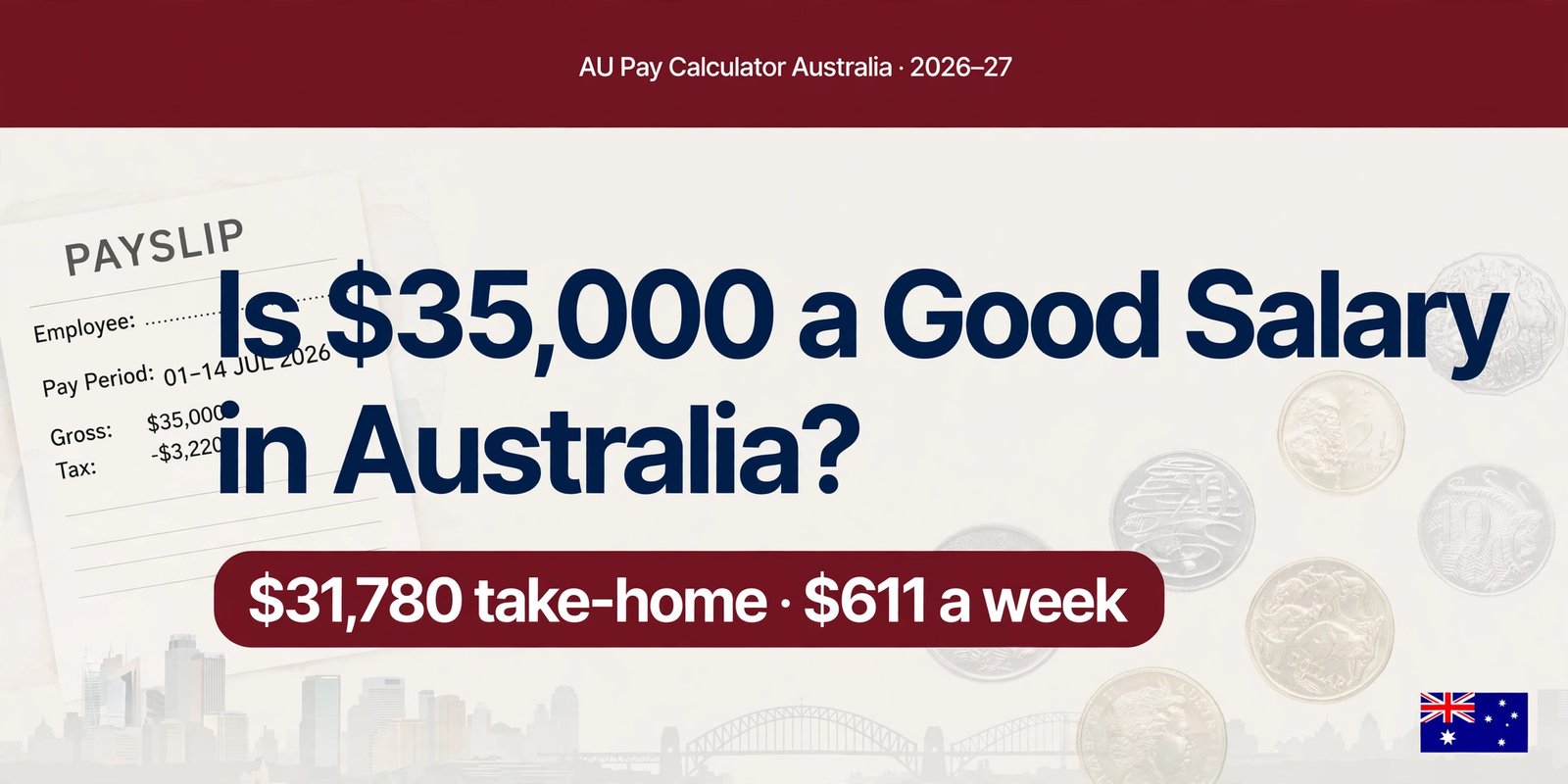
Honestly? As a full-time salary, no — $35,000 is not a good salary in Australia in 2026–27, and the reason is simple arithmetic. After tax and the Medicare levy it leaves you with $31,780 a year, or $611.15 a week. Worse, a full-time 38-hour week at $35,000 works out to just $17.71 an hour — well below the legal national minimum wage of $26.44 an hour from 1 July 2026. So $35,000 only makes sense as a part-time income, a low-hours role, or a stepping stone while you study or build experience. All figures in this article use the legislated 2026–27 resident tax rates, including the second-bracket cut from 16% to 15%.
What Is $35,000 After Tax in 2026–27?
On $35,000 in 2026–27 you pay $2,520 in income tax and $700 in Medicare levy — total deductions of $3,220 — leaving $31,780 a year in take-home pay.
| Item | Amount |
|---|---|
| Gross salary | $35,000.00 per year |
| Income tax | −$2,520.00 |
| Medicare levy (2%) | −$700.00 |
| Take-home pay | $31,780.00 per year |
| Per month / fortnight / week | $2,648.33 / $1,222.31 / $611.15 |
| Gross per week / hourly (38-hour week) | $673.08 / $17.71 |
How the $2,520 income tax is calculated
The 2026–27 resident brackets are: $0–$18,200 nil; $18,201–$45,000 at 15%; $45,001–$135,000 at 30%; $135,001–$190,000 at 37%; $190,001 and over at 45%. On $35,000, the first $18,200 is tax-free and the remaining $16,800 is taxed at 15% — $2,520 in total — plus the 2% Medicare levy of $700.
In 2025–26 the second bracket was 16%, so the same salary attracted $2,688 in income tax. The 2026–27 cut to 15% saves you $168 a year. Check any salary with our income tax calculator.
Marginal tax rate and LITO
Your marginal tax rate on $35,000 is 15%, or 17% including the 2% Medicare levy. A $1,000 pay rise is therefore worth about $830 after tax and Medicare — you keep most of every extra dollar at this income level, which is why even a small rise or a few extra hours a week makes a real difference to your weekly budget.
No Low Income Tax Offset (LITO) is applied in these figures, because the site’s calculator does not use LITO. Your $31,780 take-home reflects the standard brackets and Medicare levy only.
HECS-HELP: nothing to repay at $35,000
In 2026–27 the HECS-HELP repayment threshold is $69,528, with a marginal rate of 15% of income above it. At $35,000 you are well below the threshold, so your HECS repayment is $0 and your take-home pay is unaffected. If you are studying now and carrying a HELP debt, that debt simply sits untouched until your income crosses $69,528. Model your own repayment with our HECS calculator.
Superannuation on $35,000
Super is paid on top of your salary, so it does not reduce take-home pay. In 2026–27 the Superannuation Guarantee rate is 12%, so your employer contributes $4,200 a year ($350 a month) to your super fund. Your total package is therefore $39,200 a year. Even at a low salary, that super adds up — $4,200 a year, compounding over decades, is a meaningful retirement balance.
The Minimum Wage Problem: $35,000 Cannot Be a Full-Time Salary
This is the most important thing to understand about $35,000. The national minimum wage from 1 July 2026 is $26.44 an hour, or $1,004.90 a week for a 38-hour week — $52,254.80 a year. A full-time job paying $35,000 a year would pay $17.71 an hour, which is $8.73 an hour below the legal minimum. No employer can legally pay that for full-time work.
So if you are being offered $35,000, it is almost certainly one of these:
- A part-time role. At the minimum wage of $26.44 an hour, $35,000 a year works out to about 25–26 hours a week (1,324 hours a year). At the casual loading rate of $33.05 an hour (minimum wage plus 25%), it is about 20 hours a week.
- A low-hours or seasonal role, such as a few shifts a week in retail or hospitality.
- A role with a salary package that includes other benefits — though even then, the cash component must still meet minimum wage laws for the hours worked.
- An underpayment. If you are working full-time hours for $35,000, you are very likely being underpaid, and you should check your award rate with the Fair Work Ombudsman. Most awards pay well above the national minimum wage.
Before accepting any $35,000 offer, ask how many hours a week it covers and check the hourly rate against your award. The $35,000 salary page shows the full breakdown.
How $35,000 Compares With Other Salaries
The average full-time salary is roughly $106,000 a year, based on average weekly ordinary time earnings of about $2,051 a week (Australian Bureau of Statistics, late 2025). At $35,000 you earn about a third of the average — roughly $71,000 a year below it. Against the full-time minimum wage of $52,254.80, $35,000 is about 33% below it — a gap of roughly $17,255 a year.
How $35,000 compares with nearby salaries
| Gross salary | Income tax | Medicare levy | Take-home pay |
|---|---|---|---|
| $30,000 | $1,770 | $600 | $27,630 |
| $35,000 | $2,520 | $700 | $31,780 |
| $40,000 | $3,270 | $800 | $35,930 |
| $45,000 | $4,020 | $900 | $40,080 |
| $50,000 | $5,520 | $1,000 | $43,480 |
These figures use 2026–27 rates with no HECS debt and no LITO. Moving from $35,000 to $50,000 lifts take-home by $11,700 a year ($225 a week) — and, crucially, $50,000 is much closer to a genuine full-time income. See the full breakdown on our $35,000 salary page.
What Does $611 a Week Actually Cover?
At $611.15 a week after tax, a single person living alone in a major city will find $35,000 very tight. Rent alone can swallow half or more of it in Sydney or Melbourne, leaving little for groceries, transport, utilities and bills. In a regional city or a smaller capital, where rents are lower, the same $611 stretches further — but it is still a modest income that demands careful budgeting.
Where $35,000 works well is as a second income or a part-time income alongside other support. As a second income in a household, $611 a week after tax is genuinely useful: it can cover groceries and bills, fund savings, or accelerate a mortgage. As a student’s income, it covers living costs while you study — especially since you pay no HECS repayments at this level. As a parent returning to work part-time, it brings in real money while keeping hours around school or childcare.
$35,000 by Life Stage
As a student, $35,000 is a solid income. It is roughly 25 hours a week at the minimum wage — enough to live on while studying full-time, with no HECS repayments to worry about until your income crosses $69,528. Keep your lifestyle modest and bank the difference; a student who saves even $100 a week graduates with more than $5,000 a year put aside.
As a single person, $35,000 is tight, especially in Sydney or Melbourne. Your $2,648 a month covers the essentials only if rent is low or shared. A share house, a regional move, or a second income stream makes the biggest difference. Saving is hard at this level, but even $50 a week adds up to $2,600 a year.
As a parent working part-time, $35,000 can be a good fit: roughly 25 hours a week leaves time for school runs and family, while $611 a week after tax makes a real contribution to the household. Check your eligibility for family payments, which can add significantly to a part-time income. Childcare costs are the key variable — if childcare eats most of the $611, fewer hours or a different arrangement may work better.
How to Increase a $35,000 Salary
Add hours first. The fastest way to grow a $35,000 income is more hours. At the minimum wage of $26.44 an hour, moving from 25 to 38 hours a week takes you from $35,000 to about $52,255 a year — and your take-home rises from $31,780 to about $45,600, a gain of roughly $266 a week. If your employer cannot offer more hours, a second part-time role or weekend shifts can do the same job.
Check your award rate. Many awards pay above the national minimum wage — retail, hospitality, health and community services all have their own rates, plus penalty rates for evenings, weekends and public holidays. If you are on the minimum wage but your award says more, you may be underpaid. Penalty rates can also lift a part-time income substantially: weekend shifts at time-and-a-half or double time are worth far more per hour than a weekday shift.
Build skills that pay more. The real prize is moving into the $50,000–$70,000 range, where full-time work becomes possible and take-home jumps to $43,480–$57,000 a year. A certificate, licence, short course or traineeship can be the bridge: aged care, childcare, warehousing, administration and trades all have entry paths that pay well above the minimum wage within a year or two. Moving from $35,000 to $50,000 is worth an extra $11,700 a year in take-home pay — a return that justifies real investment in your skills.
Frequently Asked Questions
Is $35,000 a good salary in Australia in 2026–27?
As a full-time salary, no — it works out to $17.71 an hour, below the legal minimum wage of $26.44 an hour. As a part-time income of about 25 hours a week at the minimum wage, it is fair pay for the hours worked, and it works well as a second income, a student income, or a part-time return to work. The after-tax figure is $31,780 a year, or $611.15 a week.
How much is $35,000 after tax in Australia?
In 2026–27, $35,000 after tax is $31,780 a year: $2,520 income tax plus $700 Medicare levy. That is $2,648.33 a month, $1,222.31 a fortnight, or $611.15 a week. There is no HECS repayment at this income, since it is below the $69,528 threshold.
What is the hourly rate for $35,000 a year?
On a standard 38-hour week, $35,000 is $17.71 an hour before tax — below the national minimum wage of $26.44 an hour from 1 July 2026. After tax, it is roughly $16.07 an hour, based on $31,780 over 52 weeks of 38 hours. At the minimum wage, $35,000 a year equals about 25–26 hours of work a week.
How much tax do you pay on $35,000 in Australia?
$2,520 in income tax plus $700 in Medicare levy — $3,220 in total. The tax is 15% on the $16,800 between $18,201 and $35,000. The 2026–27 cut from 16% to 15% saves $168 a year versus 2025–26, when the tax was $2,688.
Can you live on $35,000 a year in Australia?
On your own in a major city, it is very tight — rent alone can take half of $611 a week. In a regional area, in a share house, or as a second household income, it is workable. As a part-time or student income it is a reasonable amount; as a sole full-time income it is not enough, and it would also be below the legal minimum wage for full-time hours.
Is $35,000 a good salary for a part-time job?
Yes, if the hours match. At the minimum wage of $26.44 an hour, $35,000 is about 25 hours a week — a typical part-time load. Check that your hourly rate is at least $26.44 (or your award rate, if higher), and remember you also get $4,200 a year in employer super on top, plus penalty rates for weekend and evening work where they apply.
The Bottom Line
$35,000 is not a good full-time salary in Australia in 2026–27 — it cannot be, because $17.71 an hour is below the $26.44 minimum wage. But as a part-time income it is exactly what it should be: $31,780 a year after tax, $611.15 a week, with $4,200 a year in super on top and no HECS repayments. The question to ask is not whether $35,000 is good, but whether the hours behind it are fair — and what your next step is. More hours, a higher award rate, or a skill that moves you toward $50,000 and beyond are all worth more than the $168 the 2026–27 tax cut saved you. Check your exact figures on our $35,000 salary page and with our income tax calculator.